


Study the Diagrams Below and use them to Answer the Questions That Follow “a to i”.
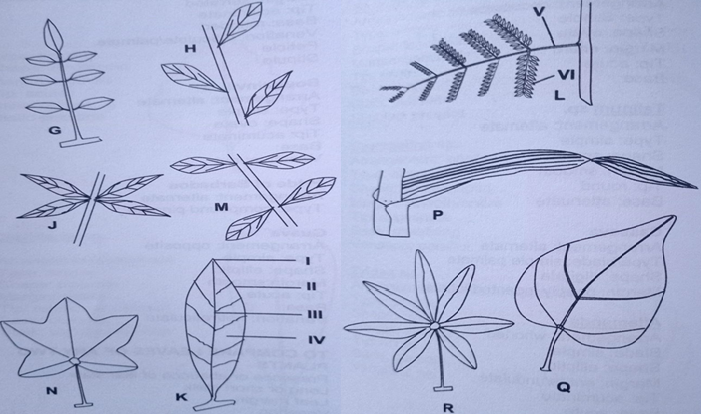 a) Identify the leaf arrangements in diagrams H, J, and M.
Answer:
- Specimen H: Alternate
- Specimen J: Whorled
- Specimen M: Opposite/Decussate
b) Give one example each of plants that have the leaf arrangements in H, J, and M.
Answer:
Examples of alternate leaf arrangement (Specimen H)
- Talinum,
- Crotalaria,
- Bougainvillea,
- Mango
- Hibiscus
Examples of whorled leaf arrangement (Specimen J)
- Allamanda
Examples of opposite leaf Arrangement (Specimen M)
- Ixora,
- Guava,
- white mangrove
c) Name the leaf shape in diagrams N, P, Q, and R.
Answer:
- Specimen N: Palmate
- Specimen P: Linear
- Specimen Q: Cordate
- Specimen R: Digitate
d) Give one example each of the plants that possess the leaf shapes in (c) above.
Answer:
Examples of plants with palmate leaves
- Pawpaw,
- Cotton,
- Okro,
- watermelon,
- castor oil,
- Jathropha,
- sweet potato,
Examples of plants with linear leaves
- Maize,
- Guinea grass,
- elephant grass
Examples of plants with cordate leaves
- Hibiscus,
- Yam
Examples of plants with digitate leaves
- Cassava,
- silk cotton
e) Name the parts labelled I to VI.
Answer:
- I: Apex
- II: Margin
- III: Midrib
- IV: Blade/Lamina
- V: Leaf stalk/petiole
- VI: Leaflet
f) State one function of the part labelled V
Answer:
- It supports the leaf
g) Name the type of leaf in G with a reason.
Answer:
- Type of leaf in G is Pinnate
Reason:
- The leaf blade is divided into several leaflets, which are arranged along the main stalk
h) State two features of the leaf in K that adapt it to its functions.
Answer:
- The leaf blade is broad and flat to provide a large surface area for maximum absorption of sunlight and carbon dioxide
- An extensive network of veins is a transport system that brings water to the leaf and also removes products of photosynthesis.
i) State the classes of the leaves in P and Q with reasons.
Answer:
P: Class Monocotyledoneae
Reasons:
- Presence of parallel venation
- Presence of leaf sheath
- The leaf is narrow
Q: Class Dicotyledoneae
Reasons:
- Presence of net venation
- Presence of leaf stalk
- The leaf is broad.