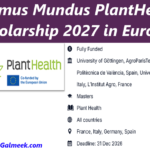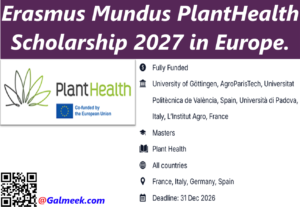


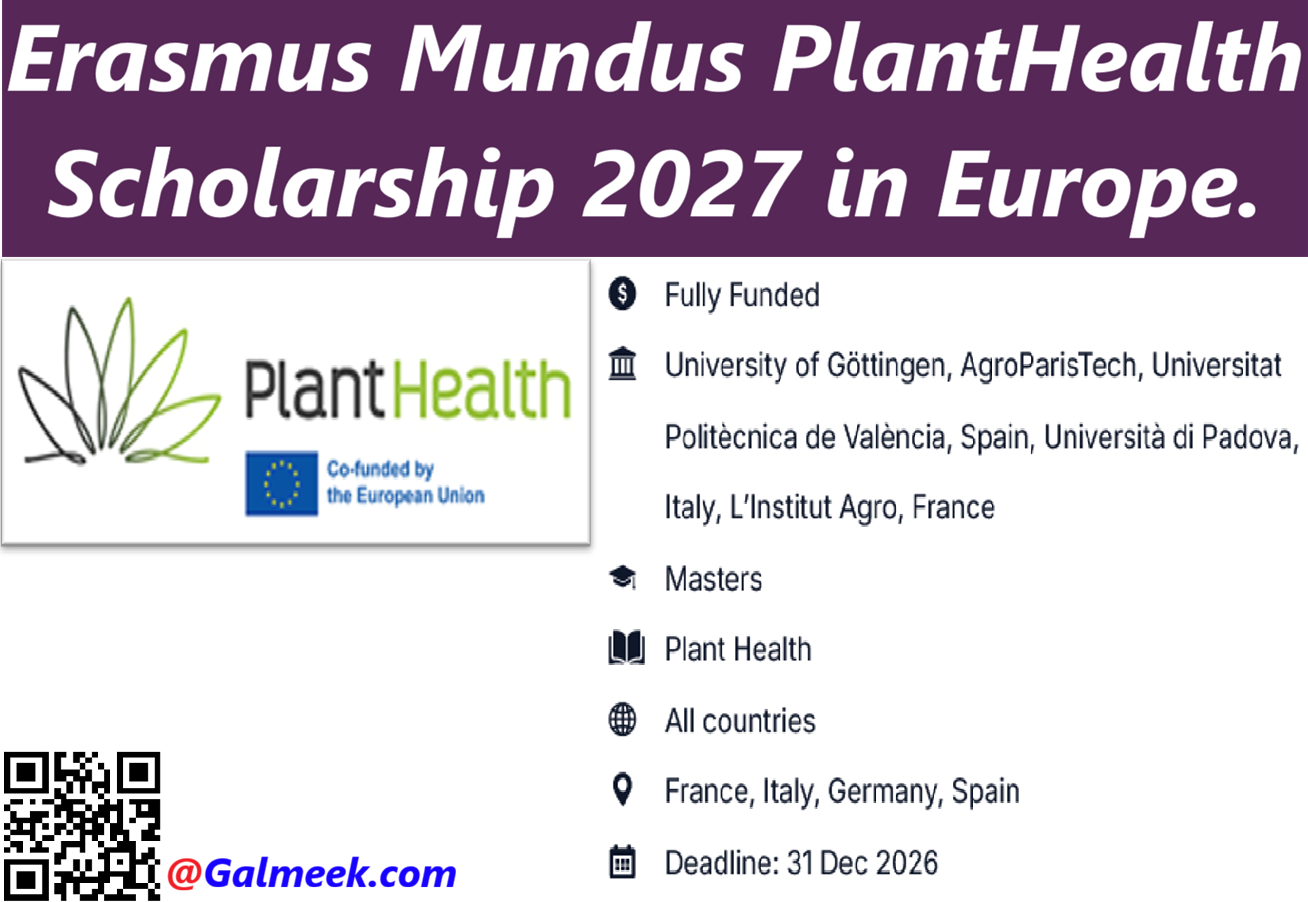
The Erasmus Mundus PlantHealth Scholarship 2027–29 offers international students an opportunity to pursue a fully funded joint Master’s degree in Plant Health in Sustainable Cropping Systems at leading European universities. The programme focuses on plant health, crop protection, sustainable agriculture and global food security.
The Erasmus Mundus Joint Master (EMJM) PlantHealth is a two-year international Master’s programme delivered by a consortium of European universities. Students benefit from specialised coursework, practical training, research activities, field trips and international mobility, with the opportunity to receive a double degree.
For the 2027–2029 intake, the first application call opened on October 1, 2026, and closes on December 31, 2026. Applicants submitting during this first call can be considered for Erasmus Mundus Joint Masters scholarships and PlantHealth Consortium scholarships.
The programme is open to applicants from around the world, including students from Pakistan, provided they meet the academic, language and other admission requirements.
Degree Level
The Erasmus Mundus PlantHealth Scholarship supports:
- Master’s degree
- Erasmus Mundus Joint Master’s programme
- Full-time postgraduate study in Plant Health in Sustainable Cropping Systems
The programme lasts two academic years and comprises 120 ECTS credits. Students undertake study and mobility across participating European universities and receive the degree or degrees associated with their approved academic pathway.
The first and second years form one integrated programme. Students selected for the programme are admitted to both years rather than applying separately for each year.
Available Subjects
The PlantHealth programme focuses on plant health management and sustainable cropping systems. It is intended for students who want to develop scientific and practical expertise in protecting crops and improving agricultural sustainability.
Relevant study areas include:
- Plant Health
- Crop Protection
- Agronomy
- Agricultural Sciences
- Plant Pathology
- Plant Diseases
- Entomology
- Agricultural Entomology
- Weed Science
- Plant Protection
- Sustainable Agriculture
- Sustainable Cropping Systems
- Integrated Pest Management
- Crop Production
- Plant–Environment Interactions
- Agricultural Biotechnology
- Sustainable Food Production
- Environmental Sustainability
- Global Food Security
- Agricultural Research
The programme combines scientific knowledge with practical approaches to managing plant health challenges. Applicants should ensure that their previous academic background is relevant to the programme’s admission requirements.
Participating Universities
The Erasmus Mundus PlantHealth programme is delivered by a consortium of European higher education institutions.
The participating universities listed by the programme include:
- Universitat Politècnica de València, Spain
- Università di Padova, Italy
- University of Göttingen, Germany
- AgroParisTech, France
- L’Institut Agro, France
Students undertake mobility according to the programme’s approved academic pathways. The consortium assigns students to their academic mobility routes based on factors such as programme requirements, academic profile, and the distribution of students among partner universities.
Students may express their mobility preferences, but their preferred route is not guaranteed.
Benefits
Successful Erasmus Mundus scholarship recipients receive comprehensive financial support for the two-year programme.
The Erasmus Mundus Joint Masters scholarship includes:
- Full coverage of tuition and other participation costs.
- Compulsory health insurance.
- A monthly stipend of €1,400 for up to 24 months.
- Financial support intended to contribute toward living expenses.
- Support for travel, visa, and installation costs through the scholarship allowance.
- Opportunities to study at partner universities in different European countries.
- Access to international academic and research networks.
- Practical training, field trips, case studies, and research activities.
- The opportunity to complete a Master’s thesis and gain experience relevant to plant health and sustainable agriculture.
The monthly stipend is intended to support travel, visa, installation, and living expenses during the scholarship period. Applicants should review the official financial-support conditions to understand the full terms of the award.
The Erasmus Mundus Joint Masters scholarship is designed to cover the programme’s participation costs, including tuition fees and compulsory insurance, and provides a monthly allowance of €1,400 for up to 24 months.
The scholarship is therefore considered fully funded for the eligible programme costs and the financial support specified by the Erasmus Mundus award.
However, students should still read the scholarship agreement carefully because some personal or exceptional expenses may not be covered separately.
PlantHealth also offers Consortium scholarships for selected candidates. These may provide tuition-fee waivers but do not cover travel, accommodation or living expenses. They should not be confused with the fully funded Erasmus Mundus scholarship.
Eligible Nationalities
The Erasmus Mundus PlantHealth programme is open to applicants from around the world.
Both EU and non-EU applicants can be considered for Erasmus Mundus Joint Masters scholarships, subject to the applicable eligibility requirements.
Applicants from Pakistan, India, Bangladesh, Nigeria, Egypt and other countries may apply if they meet the programme’s academic and other admission conditions.
The scholarship does not require applicants to hold European nationality. However, candidates who have previously received an Erasmus Mundus Joint Masters scholarship are not eligible to receive another EMJM scholarship under the programme’s stated restrictions.
Eligibility Criteria
Applicants for the Erasmus Mundus PlantHealth Scholarship 2027–29 must meet the admission requirements of the programme.
The main requirements include:
- Hold a Bachelor of Science degree worth 180 ECTS or an equivalent qualification.
- Have a degree in Agronomy, Agricultural Sciences, or a related field.
- Have at least 4 ECTS in Plant Health or Crop Protection, or equivalent academic preparation.
- Demonstrate English proficiency at CEFR B2 level, unless eligible for an exemption.
- Submit a complete online application.
- Provide two recommendation letters using the official PlantHealth reference template.
- Upload all mandatory documents.
- Meet the requirements of the partner universities for enrolment.
- Not have previously received an Erasmus Mundus Joint Masters scholarship if applying for EMJM funding.
Students in the final year of their Bachelor’s degree may apply, provided they complete the required qualification before enrolment.
Meeting the minimum eligibility criteria does not guarantee admission or a scholarship because the programme is selective.
Academic Requirements
Applicants must hold a relevant Bachelor’s degree equivalent to 180 ECTS credits, usually corresponding to a three-year full-time undergraduate degree.
The degree should be in Agronomy, Agricultural Sciences or a related field. Applicants must also demonstrate at least 4 ECTS in Plant Health or Crop Protection, or equivalent academic preparation.
Students whose degrees are awarded under a different credit system should review the programme’s official admission guidance to determine whether their qualifications meet the requirements.
Applicants who are still completing their first higher education degree may apply during their final year, but they must meet the degree requirement by the time of enrolment.
English Language Requirements
Applicants must demonstrate English proficiency at CEFR B2 level, unless English is their native language or they qualify for an accepted exemption.
The programme accepts recognised English-language evidence, including:
- IELTS
- TOEFL iBT
- Cambridge English Qualifications
- Trinity College London Integrated Skills in English
- ESOL qualifications covering listening, reading, writing and speaking
- Oxford Test of English
- Pearson Test of English (PTE)
Applicants whose Bachelor’s degree was taught entirely in English may submit an official letter from their university confirming English as the language of instruction.
Although the programme accepts this alternative, including an English-language certificate may strengthen the application. Applicants should check the current application instructions for the exact evidence and document requirements.
Required Documents
Applicants must submit a complete online application with the required supporting documents.
The application generally requires:
- Curriculum vitae or résumé
- Bachelor’s degree certificate or proof of completed qualifications
- Complete academic transcripts
- English-language proficiency certificate, where required
- Two recommendation letters using the official PlantHealth template
- Declaration on honour
- Information about the applicant’s academic background
- Preferred mobility pathway
- Other relevant documents, such as publications or proof of refugee status, where applicable
Applicants who have completed additional qualifications, such as a Master’s or PhD, should also provide copies of those degree certificates and transcripts where requested.
Documents must be submitted in English unless the programme’s instructions specify otherwise. Incomplete applications are not considered.
How Winners Are Selected
The PlantHealth programme uses a competitive selection process to admit students from around the world.
The assessment considers whether applicants meet the academic and language requirements and whether their qualifications are suitable for the programme.
Applicants must submit all required documents, including two recommendation letters. The consortium also considers the candidate’s academic profile when assigning mobility pathways.
The programme expects to publish the first-call list of accepted candidates and scholarship recipients at the end of February 2027.
Applicants should note that admission to the programme does not automatically mean that they have received an Erasmus Mundus scholarship. Scholarship awards are confirmed separately through the selection process.
Application Procedure
Applications for the Erasmus Mundus PlantHealth Scholarship are submitted online through the programme’s official application system.
Step 1: Check Your Eligibility
- Review the academic, English-language, and other admission requirements. Confirm that your Bachelor’s degree is relevant to Agronomy, Agricultural Sciences, or a related field and includes the required Plant Health or Crop Protection background.
Step 2: Review the Programme
- Explore the Plant Health curriculum, partner universities, mobility pathways, and research opportunities. Consider how the programme fits your academic background and career goals.
Step 3: Prepare Your Documents
- Prepare your CV, degree certificate, transcripts, English-language evidence, and other required documents before starting the application.
Step 4: Arrange Two Recommendation Letters
- Ask two suitable referees to complete the official PlantHealth recommendation template. Make sure both letters include the required referee contact details, signature, and institutional or company stamp.
Step 5: Create an Online Account
- Register through the official PlantHealth application portal by creating a user account and providing your email address.
Step 6: Complete the Application Form
- Fill in the application form in English, upload all mandatory documents, and indicate your preferred mobility pathway.
Step 7: Submit During the First Call
- Submit your complete application by December 31, 2026, to be considered for the Erasmus Mundus Joint Masters scholarship or PlantHealth Consortium scholarship.
Step 8: Wait for the Selection Results
- The programme expects to publish the list of accepted candidates and scholarship awardees at the end of February 2027.
- Applicants should monitor their email and the official programme website for selection updates and further instructions.
Application Deadline
For the PlantHealth Master’s intake 12, covering the 2027–2029 academic years, the application schedule is:
- First call opens: October 1, 2026
- First call closes: December 31, 2026
- Admission and scholarship results: Expected at the end of February 2027
- Second application round: May 20–June 15, 2027
Only applicants applying during the first call can be considered for Erasmus Mundus Joint Masters scholarships or PlantHealth Consortium scholarships.
The second round is intended for self-funded candidates or applicants with external funding. It does not offer Erasmus Mundus scholarships.