

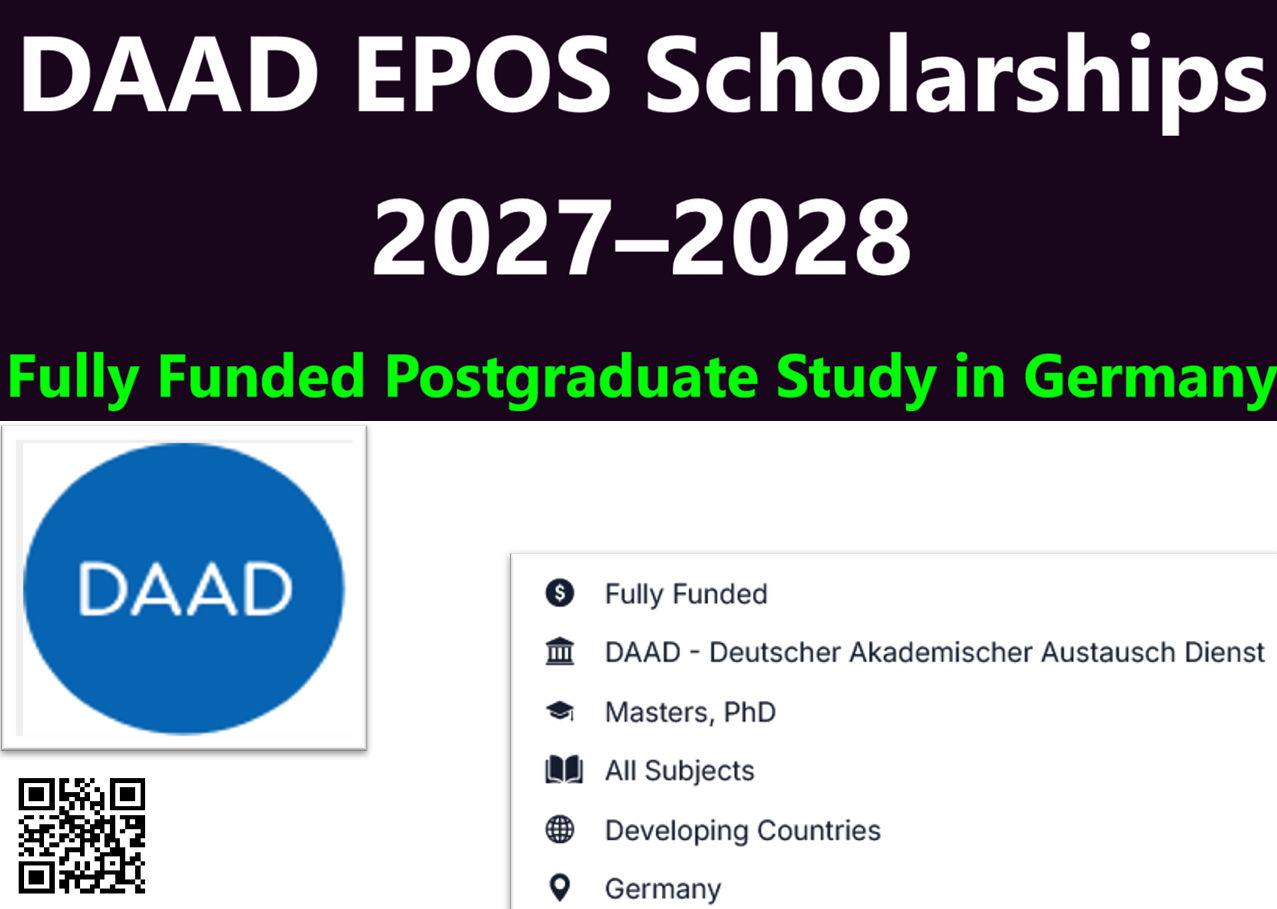
The DAAD Development-Related Postgraduate Courses (EPOS) Scholarships 2027–28 offer international graduates from eligible developing and emerging countries the opportunity to pursue selected postgraduate and Master’s degree programs at state or state-recognized universities in Germany.
Funded by the German Academic Exchange Service (DAAD), the program is designed for academically strong professionals who have relevant work experience and want to gain advanced qualifications that can contribute to the development of their home countries.
The EPOS program includes a wide range of development-related Master’s and postgraduate courses covering areas such as economics, environmental sciences, engineering, public health, agriculture, urban planning, development management, and other fields.
The program is based on the idea that highly qualified professionals with international networks can contribute to sustainable development in their home countries. Selected applicants receive scholarships to study eligible postgraduate programs at participating German universities and institutions.
The scholarship is not available for every Master’s program in Germany. Applicants must choose a course specifically included in the official DAAD EPOS list. For the 2027/2028 intake, DAAD has published an official list of participating courses and their individual application deadlines. Some programs have an annual intake, while others have intake cycles every two years.
Degree Level
The DAAD EPOS program primarily supports:
- Master’s degrees
- Postgraduate degree programs
- In exceptional cases, doctoral studies
The exact degree level depends on the selected EPOS course.
Most participating programs are Master’s degrees with study durations ranging from approximately 18 to 24 months, although the overall scholarship duration can vary from 12 to 42 months depending on the selected program.
Available Subjects
The DAAD EPOS program covers postgraduate courses in a broad range of development-related disciplines.
Depending on the academic year and participating institutions, available fields can include:
- Economic Sciences
- Business Administration
- Development Economics
- Development Management
- Development Cooperation
- Engineering
- Renewable Energy
- Environmental Sciences
- Natural Resources Management
- Agriculture
- Forestry
- Urban and Regional Planning
- Geography
- Environmental Governance
- Public Health
- Medicine
- Sustainable Development
- Water Resources Management
- Food and Nutrition
- Social Sciences
- Other development-related disciplines
For 2027/2028, the official DAAD course list includes programs such as Development Economics, Development Management, Hydro Science and Engineering, Sustainable Renewable Energy Technologies, Agricultural Economics, Environmental Governance, Urban Management, and several other specialized Master’s programs.
Benefits
The DAAD EPOS Scholarship provides substantial financial support for successful applicants.
Depending on the applicant’s academic level and circumstances, benefits may include:
- Monthly scholarship of €992 for graduates
- Monthly scholarship of €1,400 for doctoral candidates
- Health insurance
- Accident insurance
- Personal liability insurance
- Travel allowance, where applicable
- Monthly rent subsidy under certain conditions
- Additional allowance for accompanying family members under certain conditions
The current DAAD information states that the doctoral scholarship rate is €1,400 per month from February 2026.
The scholarship duration depends on the selected postgraduate course and can range from 12 to 42 months.
Eligible Nationalities
- The DAAD EPOS Scholarships are intended for graduates from eligible developing and emerging countries.
- Applicants must be citizens of a country included in the official DAAD EPOS list of eligible countries.
- Eligibility is therefore not based simply on being an international student. Applicants should check the current DAAD country list before applying.
Eligibility Criteria
The general EPOS eligibility requirements include:
- Be a graduate from an eligible developing or emerging country.
- Hold a Bachelor’s degree or equivalent qualification in an appropriate field.
- Have an excellent academic record.
- Usually have at least two years of relevant professional experience after completing the first degree.
- Demonstrate development-related motivation.
- Show potential to contribute to positive change in the applicant’s professional or social environment.
- Meet the academic requirements of the selected postgraduate course.
- Meet the language requirements of the chosen program.
- Submit the application within the deadline specified by the selected course.
DAAD states that applicants should generally have completed their academic degree with above-average results, typically placing them in the upper third of their graduating class.
Applicants’ academic degrees should normally not be more than six years old.
Applicants who have been resident in Germany for more than 15 months at the application deadline generally cannot be considered for the EPOS scholarship.
Professional Experience Requirement:
- Relevant professional experience is one of the key features of the EPOS program.
- Applicants generally need at least two years of relevant professional experience after completing their first university degree.
- The ideal EPOS applicant typically has professional experience related to development-oriented work, such as employment with a public authority, government organization, company, institution, or development-related organization.
- Professional experience should be relevant to the selected postgraduate program and demonstrate how the applicant’s future studies can contribute to development in their professional or home environment.
Language Requirements:
- Language requirements depend on the selected postgraduate course.
- For English-taught programs, applicants must provide proof of adequate English-language proficiency according to the requirements of the individual course.
- For German-taught programs, specific German-language requirements apply. DAAD notes that applicants for German-language courses generally need at least B1 German knowledge when applying because they must be able to successfully complete the required language preparation and examination before beginning their degree program.
- Applicants should always check the language requirements listed by their chosen EPOS course.
Selection Criteria:
EPOS applicants are assessed on several factors, including:
- Academic performance
- Relevant professional experience
- Quality of the application
- Motivation for studying the selected course
- Development-related motivation
- Language skills
- Suitability for the chosen postgraduate program
- Potential to contribute to development after completing the program
DAAD particularly emphasizes applicants who can demonstrate that their education and professional experience are connected to development-related challenges and that they intend to use their knowledge and qualifications to contribute to positive change.
Application Procedure
One of the most important aspects of the DAAD EPOS application process is that applicants generally apply directly to the selected postgraduate course, not directly to DAAD at the initial stage.
The general process is:
- Review the official list of DAAD EPOS courses.
- Check whether you are eligible for the program and the selected course.
- Choose up to three eligible postgraduate courses if you wish to apply to multiple programs.
- Review the individual admission and scholarship requirements of each course.
- Prepare the required documents.
- Submit your complete application directly to the selected postgraduate course or university.
- The course’s selection committee reviews applications and nominates potential DAAD scholarship candidates.
- DAAD contacts candidates who have been nominated for the scholarship.
- Nominated candidates upload their complete scholarship documents to the DAAD portal.
- DAAD completes the final scholarship selection process.
Applications sent directly to DAAD, rather than the relevant postgraduate course, are not forwarded to the university.
Required Documents:
The exact documents vary by course, but typical EPOS application materials can include:
- Completed application form
- Curriculum vitae
- Motivation letter
- Academic transcripts
- Bachelor’s degree certificate
- Proof of professional experience
- Language certificate
- Recommendation letters, where required
- Other documents requested by the selected university or course
When applying to more than one EPOS course, applicants must explain their course choices and priorities in their motivation letter.
DAAD states that applications must be complete and submitted in English or German. Individual programs may require additional documents.
Can You Apply for More Than One EPOS Course?
- Applicants can apply for up to three eligible EPOS postgraduate courses.
- If applying to more than one course, applicants must rank their choices by priority and explain the reasons for their selection and prioritization in their motivation letter.
Applicants should carefully review the application instructions of each selected course because individual universities may have additional requirements or procedures.
Important Dates:
- There is no single application deadline for all DAAD EPOS Scholarships.
- For the 2027/2028 intake, each participating postgraduate course has its own application deadline.
- The official DAAD deadline list includes individual deadlines for different programs, and some courses state that applicants should follow the deadline published on the respective course website.
Therefore, applicants should:
- Select their preferred EPOS course.
- Check its official application deadline.
- Prepare documents well in advance.
- Submit the application directly to the relevant course before its deadline.
The official DAAD 2027/2028 deadline list is the most reliable source for checking the current deadlines.