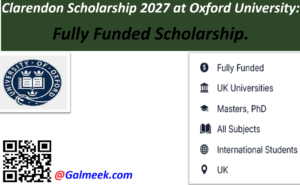


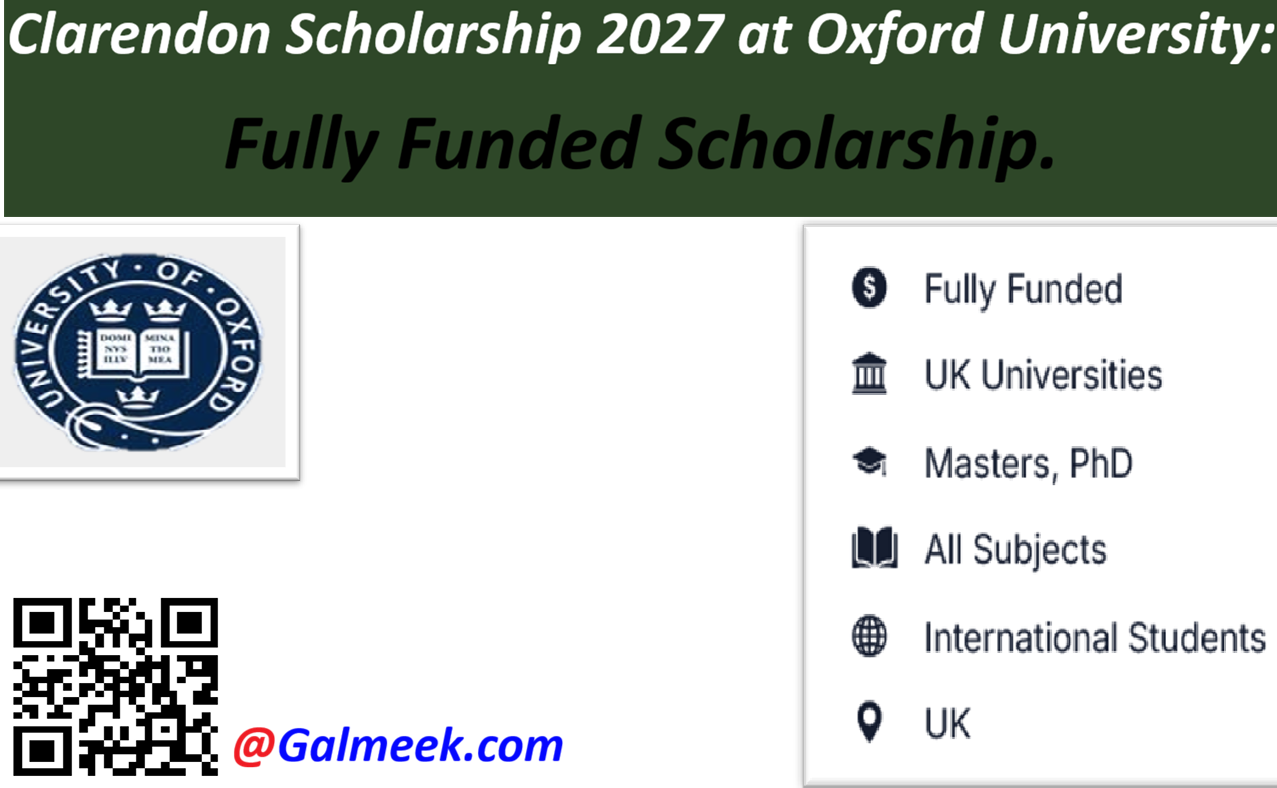
The Clarendon Scholarship 2027 at the University of Oxford is a fully funded graduate scholarship for outstanding students from around the world. The scholarship supports students pursuing eligible Master’s and DPhil programmes at Oxford University and is awarded based on academic excellence and future potential.
The Clarendon Fund offers around 200 new fully funded scholarships each year. There are no restrictions based on nationality, country of ordinary residence, or field of study. Both full-time and part-time eligible Master’s and DPhil courses can be considered.
Clarendon scholarships cover course fees in full and provide a grant for living expenses for the period of fee liability of the scholar’s course. For full-time scholars, the living-cost grant is at least the UKRI minimum doctoral stipend rate. For 2025–26, this was at least £20,780, while the amount for 2027–28 will depend on the applicable rate and scholarship arrangements.
The Clarendon Scholarship is not a separate scholarship application. Students who apply for an eligible new graduate course at Oxford by the relevant December or January admissions deadline are automatically considered.
Degree Level
The Clarendon Scholarship is available for eligible:
- Master’s programmes
- DPhil programmes
- Full-time graduate courses
- Part-time graduate courses
Applicants must be applying for a new graduate course at the University of Oxford.
Available Subjects
The Clarendon Fund has no restrictions on subject area.
Students can apply for eligible Oxford graduate programmes across disciplines such as:
- Engineering
- Computer Science
- Artificial Intelligence
- Business and Economics
- Law
- Medicine
- Public Policy
- International Relations
- Social Sciences
- Humanities
- Natural Sciences
- Environmental Sciences
- Mathematics
- Physics
- Chemistry
- Biological Sciences
- Education
- History
- Languages
- Arts
- Other eligible graduate fields
The important requirement is that the applicant applies for an eligible new Master’s or DPhil course by the relevant Oxford admissions deadline.
Benefits
The Clarendon Scholarship provides substantial financial support throughout the eligible period of study.
Major benefits include:
- Full payment of course fees
- Annual living-cost grant for full-time scholars
- Living support for the period of fee liability
- Study support grant for eligible part-time scholars
- Opportunity to study at the University of Oxford
- Membership in the international Clarendon scholar community
- Opportunities to build academic, social, and professional connections
- Access to a multidisciplinary community of scholars from around the world
Oxford states that Clarendon scholars become part of an active international community with scholars from around 70 countries.
Is the Clarendon Scholarship Fully Funded?
Yes. The University of Oxford officially describes Clarendon as a fully funded scholarship.
For eligible full-time scholars, the scholarship covers the full course fees and provides a grant for living expenses for the period of fee liability.
For part-time scholars, Clarendon covers applicable course fees and provides a study support grant to assist with non-fee costs. The amount of this grant varies according to the course and its structure.
The exact duration and funding package are confirmed in the scholar’s offer letter.
Eligible Nationalities
- The Clarendon Scholarship is open to students from all nationalities and countries of ordinary residence.
- There are no nationality restrictions for the main Clarendon Fund. Students from around the world can be considered for the scholarship as long as they meet the academic and admissions requirements.
- Clarendon scholars come from a diverse range of countries and academic backgrounds.
Eligibility Criteria
To be considered for the Clarendon Scholarship 2027, applicants generally need to:
- Apply for a new eligible Master’s or DPhil course at Oxford.
- Submit the graduate application by the relevant December or January deadline for the chosen course.
- Demonstrate outstanding academic achievement.
- Show strong academic potential.
- Demonstrate motivation and commitment to the proposed course.
- Meet the admission requirements of the selected Oxford programme.
- Be eligible for the chosen graduate course.
- Not hold a deferred graduate offer.
The scholarship is highly competitive, and academic excellence is an essential part of the selection process.
Academic Requirements
Clarendon does not publish one universal GPA cutoff for all applicants because academic standards differ between countries, universities, subjects, and Oxford programmes.
However, Oxford states that an excellent academic record is essential, and the majority of successful Clarendon scholars usually have at least a first-class honours degree or equivalent.
Selection also considers the applicant’s motivation, commitment to the proposed course, personal statement, and referees’ reports.
Applicants should therefore focus on presenting strong academic results alongside a compelling and well-supported graduate application.
Who Cannot Apply for Clarendon?
Some applicants are not eligible for consideration.
The Clarendon Fund does not consider:
- Applicants holding deferred graduate offers.
- Current Oxford students continuing on the same degree in the following year.
However, current Oxford Master’s students who are applying for a new DPhil can be eligible. Students currently studying at Oxford may also be eligible when applying for a second Master’s course, subject to the relevant requirements.
Application Procedure
There is no separate Clarendon Scholarship application form.
Step 1: Choose an Oxford Graduate Course
- First, identify an eligible Master’s or DPhil programme at the University of Oxford that matches your academic background and goals.
Step 2: Check the Course Deadline
- Every Oxford graduate course has its own application deadlines.
- To be considered for Clarendon, you must submit your graduate application by the December or January deadline relevant to your course.
Step 3: Complete the Oxford Graduate Application
- Prepare and submit the complete Oxford graduate application, including the supporting documents required by your chosen programme.
- Your application for admission also serves as the basis for Clarendon scholarship consideration.
Step 4: Automatic Scholarship Consideration
- There is no separate Clarendon application.
- Once you submit an eligible graduate application by the relevant deadline, Oxford automatically considers you for Clarendon if you meet the scholarship eligibility criteria.
Step 5: Academic Assessment
- Your proposed academic department reviews your application for admission and academic suitability.
- Eligible candidates may then be nominated for Clarendon based on academic merit and potential.
Step 6: Divisional Selection
- Academic divisions review departmental nominations and select candidates for Clarendon funding.
Step 7: Scholarship Offer
- Successful applicants receive a Clarendon scholarship offer by email.
- Oxford states that most initial Clarendon offers are sent by the end of April, although a small number of late nominations may occur later.
Application Deadline
There is no single universal Clarendon Scholarship deadline.
For the 2027–28 academic year, applicants must submit their Oxford graduate application by the December or January deadline applicable to their chosen course.
Therefore, applicants should not rely on a single date published on third-party scholarship websites. The exact deadline should be checked on the official Oxford graduate course page.
Applying after the relevant December or January deadline means the applicant will not be considered for Clarendon.
Selection Process
Clarendon selection is highly competitive and focuses primarily on academic excellence and potential.
Oxford indicates that selection considers factors such as:
- Outstanding academic record
- Academic potential
- Motivation
- Commitment to the proposed course
- Quality of the personal statement
- Referees’ reports
- Suitability for the proposed field of study
The selection process is conducted through academic departments and Oxford’s academic divisions.
The university’s academic experts assess candidates within their respective fields before scholarship nominations are reviewed at divisional level.
When Are Clarendon Results Announced?
Oxford states that most initial Clarendon scholarship offers are sent by the end of April.
Successful candidates receive their scholarship offer by email. If an applicant has not heard from Oxford by around mid-June, Oxford advises that they should assume they have not been awarded a Clarendon Scholarship, although a small number of late nominations can occur during the summer.
Duration of the Scholarship
Clarendon scholarships are normally offered for the scholar’s period of fee liability.
This means the scholarship generally covers the period during which the student is required to pay course fees.
Some scholarships may cover an additional period of study at the discretion of the relevant academic division. In such cases, only the living-cost grant is provided during the additional period, while continuation charges are not covered.
The exact scholarship duration is stated in the scholar’s offer documentation.
Clarendon Scholarship for International Students
International students are welcome to apply.
There are no nationality or ordinary-residence restrictions for the Clarendon Fund. Students from outside the UK can apply for eligible Oxford Master’s and DPhil programmes and be considered automatically for Clarendon funding.
Applicants must still satisfy the academic and admissions requirements of their chosen Oxford course.
Why Apply for the Clarendon Scholarship?
The Clarendon Scholarship combines comprehensive graduate funding with the opportunity to join a large international academic community at Oxford.
In addition to financial support, Clarendon scholars become part of a multidisciplinary network where students from different academic backgrounds and countries can build long-term academic and professional connections.
The scholarship is therefore designed not only to reduce the financial barriers associated with graduate study but also to create a strong scholarly community at Oxford.