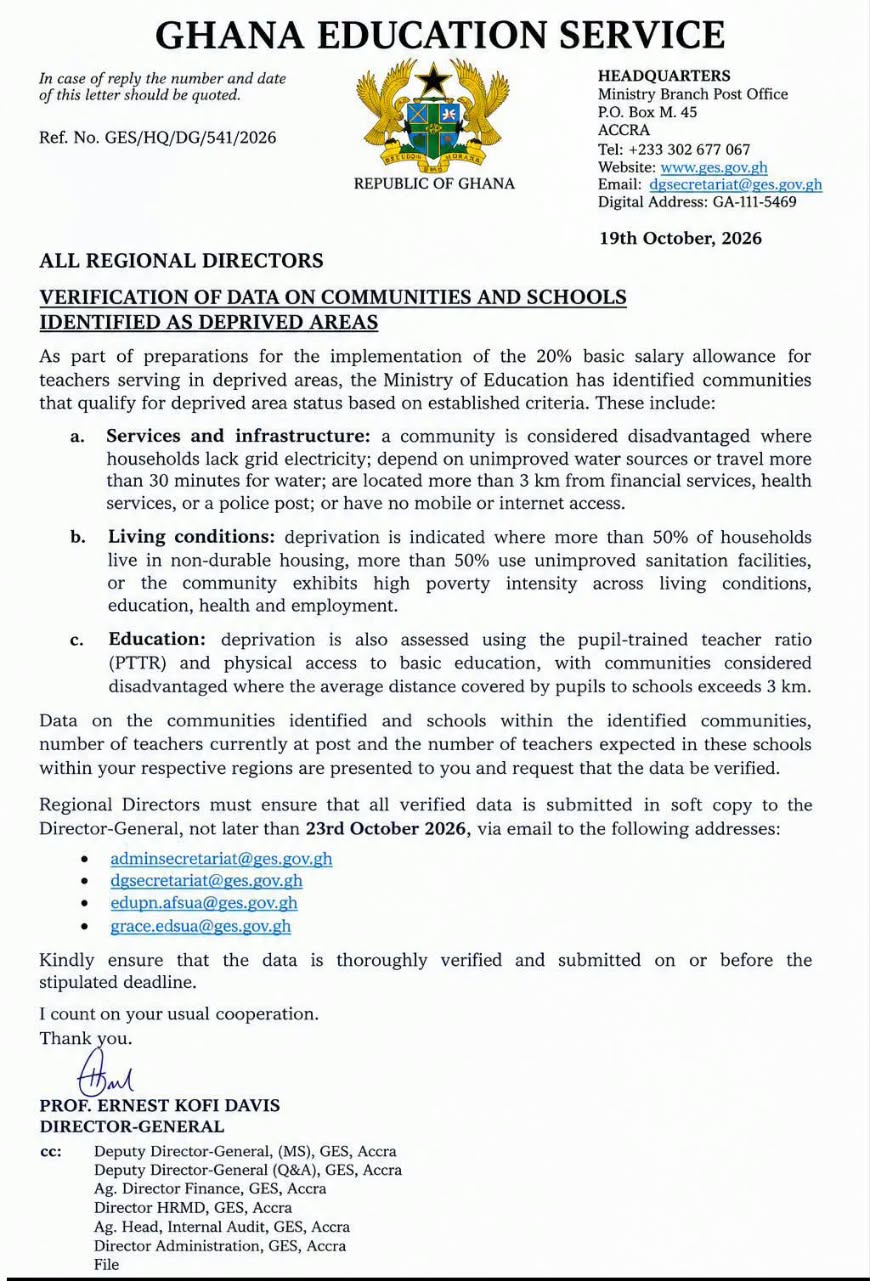



The Ghana Education Service (GES) has directed all Regional Directors of Education to verify data on communities and schools identified as deprived areas ahead of the implementation of a proposed 20% basic salary allowance for teachers serving in such locations.
In a letter dated October 19, 2026, and signed by the Director-General of GES, Professor Ernest Kofi Davis, the Service instructed Regional Directors to thoroughly verify information on identified communities, schools, the number of teachers currently at post, and the number of teachers expected to serve in the affected schools.
The directive forms part of preparations for implementing the 20% basic salary allowance intended for teachers working in deprived areas.
The Ministry of Education has identified communities that qualify for deprived-area status based on established criteria covering access to essential services, living conditions, and educational needs.
According to the letter, Regional Directors are required to submit the verified data electronically to the Director-General by Friday, October 23, 2026.
The Ministry’s criteria for identifying deprived communities include inadequate access to electricity, safe water, financial services, healthcare, police services, and telecommunications. Communities may qualify where households lack grid electricity, depend on unimproved water sources or must travel more than 30 minutes to obtain water.
Distance from essential services is also considered. Under the stated criteria, communities located more than 5 kilometres from financial services, health services or a police post may be considered disadvantaged. The absence of mobile network coverage or internet access is another indicator.
Living conditions also form part of the assessment. The criteria identify communities where more than 50% of households live in non-durable housing or use unimproved sanitation facilities. High levels of poverty across living conditions, education, health, and employment are also considered when determining deprivation.
Education-related factors are equally important in identifying eligible communities. These include the pupil-teacher ratio (PTR) and physical access to basic education. Communities are considered disadvantaged where the average distance pupils travel to school exceeds 3 kilometres.
GES has therefore asked Regional Directors to examine the data supplied to them against these criteria and confirm the accuracy of the information before submitting their reports.
The verification exercise is expected to establish a clearer picture of the communities and schools that qualify for the proposed allowance, as well as the number of teachers currently serving in those locations and the staffing levels required.
Regional Directors have been instructed to submit the verified information in soft copy to the Director-General through the email addresses provided in the official letter. The Service has stressed the need for accurate data and compliance with the October 23 deadline.