

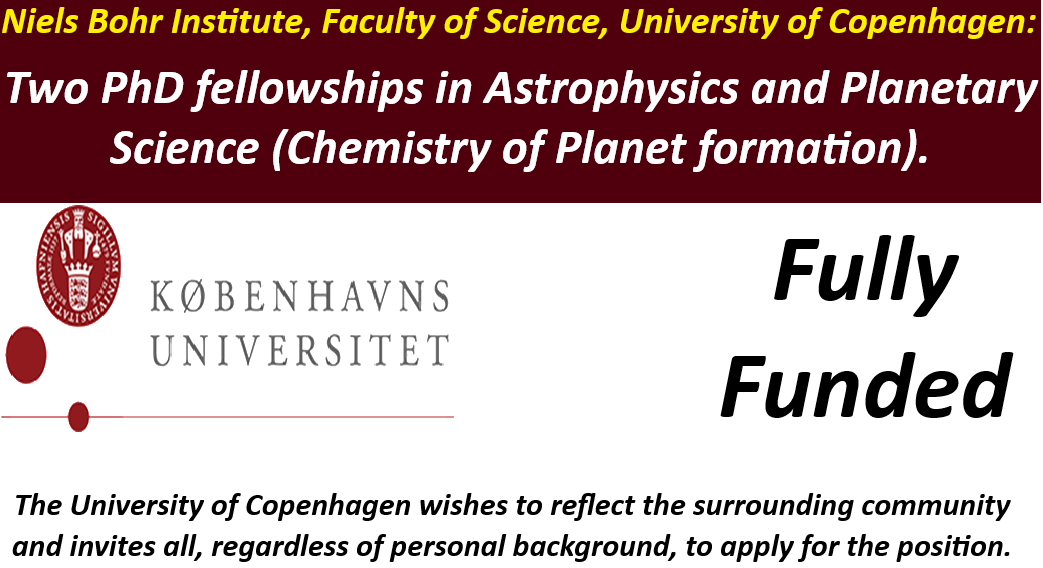
The Niels Bohr Institute/Astrophysics and Planetary Science section invites applicants for two PhD fellowships in the chemistry of planet formation.
The project is part of the Villum Young Investigator project “Chemistry meets Astrophysics: pathways to life-enabling ingredients during planet formation”.
First Project.
- The PhD project 1 will investigate how the chemical composition of planet-forming disks shapes the volatile inventories of planets.
- Recent observations with the James Webb Space Telescope (JWST) have revealed a surprising diversity in the chemistry of inner disks, including systems that appear depleted in water but enriched in hydrocarbons.
- The project will combine infrared spectroscopic observations from JWST with data from the Atacama Large (sub-)Millimeter Array (ALMA) to characterize the chemical composition and physical structure of disks around very low-mass objects.
- These observations will be complemented by numerical simulations to put firm constraints on the physical and chemical processes responsible for the observed diversity.
The project will help establish how variations in disk chemistry influence the building blocks of planets.
Start date is (expected to be) 01.09.2026 or as soon as possible thereafter.
Second Project.
- The PhD project 2 will focus on characterizing the solid budget of planet-forming disks, including both ices and refractory materials.
- The student will analyze infrared spectroscopic observations obtained with the James Webb Space Telescope (JWST), targeting a sample of protoplanetary disks.
- Spectral decomposition will be carried out using state-of-the-art fitting routines in combination with laboratory ice spectra, and the analysis will be complemented by radiative transfer modeling to derive ice column densities.
- By characterizing disk ices across a statistically significant sample, the project aims to reveal the chemical composition of the solid building blocks available for planet formation.
Start date is (expected to be) 01.01.2027 or as soon as possible thereafter.
Qualifications needed
To be eligible for the regular PhD programme, you must have completed a degree programme, equivalent to a Danish master’s degree (180 ECTS/3 FTE BSc + 120 ECTS/2 FTE MSc) related to the subject area of the project, e.g., physics, chemistry, biology.
For information on the eligibility of completed programmes, see General assessments for specific countries and Assessment database.
Employment is conditional upon your successful enrolment as a PhD student at the PhD School at the Faculty of Science, University of Copenhagen.
This requires submission and acceptance of an application for the specific project formulated by the applicant.
Terms of appointment and payment are accorded according to the agreement between the Danish Ministry of Taxation and the Danish Confederation of Professional Associations on Academics in the State.
The position is covered by the Protocol on Job Structure.
Additional qualifications:
- Professional qualifications relevant to the PhD project
- Relevant publications
- Relevant work experience
- Other relevant professional activities
- Curious mindset with a strong interest in astrophysics
- Good language skills
Responsibilities and tasks.
- Carry through an independent research project under supervision
- Complete PhD courses corresponding to approx. 30 ECTS / ½ FTE
- Participate in active research environments, including a stay at another research institution, preferably abroad
- Teaching and knowledge dissemination activities
- Write scientific papers aimed at high-impact journals
- Write and defend a PhD thesis based on your project
Application and Assessment Procedure
Your application, including all attachments, must be in English and submitted electronically by clicking APPLY NOW below.
Please include:
- Motivated letter of application describing your interest in the PhD project and how your academic background and research interests relate to the project topic. (max. one page)
- Curriculum vitae including information about your education, experience, language skills, and other skills relevant to the position.
- Original diplomas for Bachelor’s or Master’s and transcript of records in the original language, including an authorized English translation if issued in a language other than English or Danish. If not completed, a certified/signed copy of a recent transcript of records or a written statement from the institution or supervisor is accepted.
- Publication list (if possible)
Application deadline:
- The deadline for applications is 26 May 2026, 23:59 GMT +2.
For specific information about the PhD fellowship, please contact Dr. Giulia Perotti.
General information about PhD study at the Faculty of SCIENCE is available at the PhD School’s website: https://www.science.ku.dk/phd/
The University of Copenhagen wishes to reflect the surrounding community and invites all, regardless of personal background, to apply for the position.
APPLY NOW
For General Informations, Schorlaships, Intenships, Jobs, Research Grants, and Many More Both Local and International;
-
Follow to join WhatsApp Channel.
-
Telegram Channel.