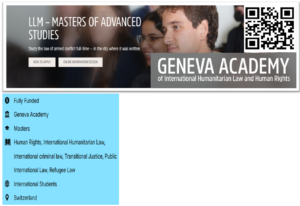


Geneva Academy Scholarships 2027 in Switzerland (Fully Funded) are open to international students. The scholarship allows Masters level program(s) in the field of Human Rights, International Humanitarian Law, international criminal law, Transitional Justice, Public International Law, Refugee Law taught at Geneva Academy.
The Geneva Academy LLM–MAS Scholarship is a fully funded master’s award offered by the Geneva Academy of International Humanitarian Law and Human Rights for law graduates from non-Western countries to study international humanitarian law, human rights, or international criminal justice in Geneva, Switzerland. The Academy is a joint centre of the University of Geneva’s Law Faculty and the Geneva Graduate Institute.
A limited number of full scholarships are awarded each year on academic merit and financial need. Each one covers the CHF 18,000 tuition fee and living expenses in Geneva for 10 months. Admission for the 2027 intake opens on 17 November 2026.
| Provider | Geneva Academy of International Humanitarian Law and Human Rights |
| Study level | Master’s (LLM–MAS, postgraduate) |
| Host country | Switzerland (Geneva) |
| Funding | Fully funded: CHF 18,000 tuition plus living costs |
| Next round | Opens 17 November 2026 for 2027 intake |
| Who can apply | Citizens of non-Western countries with a full law degree |
| Subjects | International humanitarian law, human rights, international criminal justice |
| Duration | One year, full-time (10 months) |
Degree Level
Geneva Academy Scholarships 2027 in Switzerland (Fully Funded) is available to undertake Master’s-level programs at Geneva Academy.
Two one-year, full-time LLM–Master of Advanced Studies programmes at postgraduate level: the LLM–MAS in International Humanitarian Law and Human Rights, and the LLM–MAS in International Crimes, Justice and Human Rights.
Both are 60 ECTS and taught in person in Geneva. There is no online or part-time option.
The following subjects are available to study under this scholarship program.
- Human Rights
- International Humanitarian Law
- International Criminal Law
- Transitional Justice
- Public International Law
- Refugee Law
- International Humanitarian Law and Human Rights
- International Crimes, Justice and Human Rights
- Public international law
- Human rights law
- International criminal law
- Refugee law
- Transitional justice
Core courses cover these areas; optional courses take in topics such as digital technologies, children in armed conflict, weapons law and reparations to victims. Applicants choose one of the two programmes, not a separate subject track.
Benefits
- Tuition: the full CHF 18,000 programme fee is covered
- Living costs: a contribution towards living expenses in Geneva for 10 months
- Duration: support runs for the 10 months of the programme, which starts in mid-September and ends in mid-September the following year
- Number of awards: a limited number each year, allocated on academic merit and financial need
Eligible Nationalities
Scholarships are open only to citizens of non-Western countries; the Academy publishes the full list of eligible countries on its scholarships page. Candidates of other nationalities can still apply for admission and pay the tuition fee themselves or with employer or government sponsorship.
Eligibility Criteria
To be considered for a Geneva Academy scholarship, applicants generally need to:
- Be a citizen of a non-Western country on the Academy’s published list
- Hold a full law degree that allows them to sit the bar exam in their country, or an equivalent qualification
- Show a strong academic record and a clear commitment to armed conflict, humanitarian protection or human rights work
- Provide evidence of English at C1 level, unless English is their mother tongue, their degree was taught fully in English, or they have at least two years of academic or professional experience in an English-speaking environment
- Apply during the final year of study if the diploma will be awarded by June of the admission year; admission is then conditional on completing the degree
- Choose the scholarship track at the time of application, since candidates cannot apply for both the scholarship and the regular track
Required Documents
- Law degree certificate or transcript, or proof of enrolment in the final year
- Two recommendation letters on official letterhead, signed, at least one academic
- Evidence of English at C1 level, unless an exemption applies
- Application fee payment
How Winners Are Selected
Scholarships are awarded on academic merit and financial need, with donor criteria also taken into account.
- Review of academic record and demonstrated interest in the programme’s subject area
- Assessment of financial need
- Relevant professional experience counts as an asset
- Around 35–40 students admitted per programme each year
Application Procedure
Open the official scholarships page
Start at the Geneva Academy scholarships and admissions page, where the eligible-country list and the application instructions are published. Admission opens on 17 November 2026.
Choose one programme
Decide between the LLM–MAS in International Humanitarian Law and Human Rights and the LLM–MAS in International Crimes, Justice and Human Rights. Each admits around 35–40 students a year, so the fit between your background and the programme matters.
Prepare your documents
Gather the papers the online form asks for before you start:
- Law degree certificate or transcript, or proof of enrolment in your final year
- Two recommendation letters on official letterhead, signed; at least one must be academic
- Evidence of C1 English, unless an exemption applies
- Application fee payment, which also applies to scholarship applicants
Submit the scholarship application
Complete the online application and select the scholarship track, not the regular track. The Academy states that applicants must choose one or the other at the time of application.
Wait for the decision and the offer
The Academy assesses candidates on academic merit and financial need. Payment modalities and deadlines for the tuition fee are sent to admitted candidates together with the offer of admission.