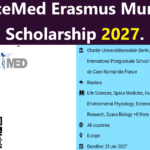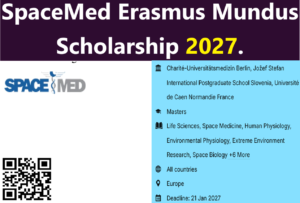


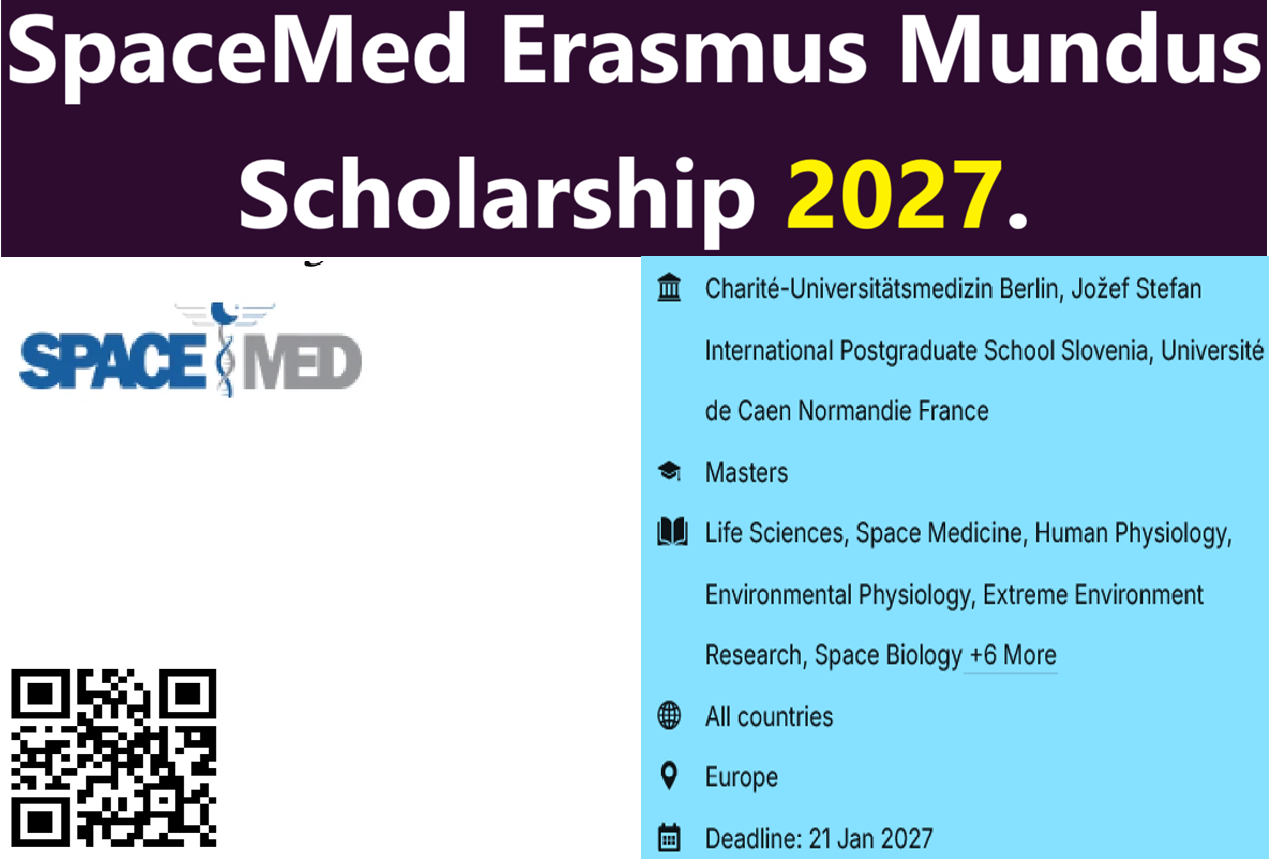
The SpaceMed Erasmus Mundus Joint Master’s programme is an international Master’s programme focusing on the effects of spaceflight and extreme environments on human physiology and health. The programme combines life sciences, medicine, physiology, research methods and experimental studies to prepare graduates for careers in space medicine and related research fields.
The programme is jointly organised by three European institutions: Charité – Universitätsmedizin Berlin in Germany, the Jožef Stefan International Postgraduate School in Slovenia and Université de Caen Normandie in France.
For the 2027 intake, applicants from all countries can apply for admission and compete for Erasmus Mundus Joint Master scholarships. Selected scholarship recipients receive €1,400 per month for 24 months, amounting to €33,600 in total, and a waiver of the programme participation fees.
Students study in different European countries during the programme, participate in laboratory and field-based research, and complete a six-month Master’s thesis or internship. The programme also provides opportunities to engage with research institutions, space agencies and industry partners.
Degree Level
The SpaceMed Erasmus Mundus programme offers a two-year, full-time Master’s degree consisting of four semesters and 120 ECTS credits.
The programme includes:
- Semester 1: France – Caen.
- Semester 2: Germany – Berlin.
- Semester 3: Slovenia – Ljubljana.
- Semester 4: Master’s thesis or internship, which may be completed at an eligible partner institution or associated organisation.
Students complete academic courses, practical activities, research projects and a six-month Master’s thesis or industrial placement.
Available Subjects
The programme focuses on the physiology and medicine of humans in space and extreme environments. Its interdisciplinary curriculum covers:
- Space Medicine
- Human Physiology
- Environmental Physiology
- Life Sciences
- Extreme Environment Research
- Space Biology
- Human Biology
- Exercise and Kinesiology
- Psychology and Neuropsychology
- Biomedical Research
- Research Methods and Data Analysis
- Human Health and Performance
The curriculum also addresses spaceflight effects, hypoxia, hyperoxia, thermoregulation, gravity and acceleration, isolation, confinement, cardiovascular deconditioning, muscle loss, sleep and circadian rhythms.
Successful Erasmus Mundus scholarship recipients receive:
- Monthly scholarship of €1,400 for 24 months.
- Total financial support of €33,600 over the two-year programme.
- Full waiver of the SpaceMed programme participation fees.
- Opportunity to study at three European partner institutions.
- Access to laboratory facilities and practical research activities.
- Opportunities to participate in research projects and space-related scientific activities.
- International academic and professional networking.
- A six-month Master’s thesis or industrial placement.
The participation fee waiver covers programme registration, teaching activities, student services, and the insurance included in the programme participation fees.
Important funding clarification: SpaceMed does not provide separate additional funding for travel, accommodation, or visa expenses. The €1,400 monthly scholarship is intended to contribute to students’ living and related costs. Applicants should plan their budgets accordingly.
Eligible Nationalities
The SpaceMed Erasmus Mundus Scholarship is open to applicants from all countries. Students do not need to be citizens of a European country to apply.
Applicants from Pakistan, India, Bangladesh, Nigeria, Indonesia, China, the United States, and other countries worldwide can compete for the scholarship.
However, the programme applies a nationality balance rule: no more than two nationals from the same country can receive an Erasmus Mundus scholarship in the relevant selection.
Eligibility Criteria
Applicants must meet the following academic and language requirements:
Academic Requirements
Candidates must hold one of the following qualifications:
- A Bachelor’s degree in Life Sciences, Psychology or Kinesiology, equivalent to 180 ECTS credits.
- A Master’s degree in Engineering.
- A Medical degree.
- Another degree that includes significant academic study of humans in space or extreme environments.
Applicants who are completing their final academic year may also apply, provided they obtain their required qualification before enrolment.
The programme begins in October, and applicants must provide proof of their Bachelor’s or other qualifying degree before university enrolment.
English Language Requirements
Applicants must demonstrate English proficiency equivalent to at least B2 under the Common European Framework of Reference for Languages (CEFR).
The programme accepts the following evidence:
- IELTS: Minimum overall score of 6.5.
- TOEFL: Minimum 580 (paper-based), 237 (computer-based) or 87 (internet-based).
- Cambridge English Qualifications: B2 First.
- A declaration of honour for applicants whose native language is English.
- An official certificate from the previous university confirming that the applicant’s studies were conducted in English.
The programme does not accept the Online Linguistic Support (OLS) test as valid proof of English proficiency. Accepted language certificates must not be older than three years.
Required Documents
Applicants must prepare the following documents for the online application:
- Curriculum Vitae: An updated CV. The Europass CV format is highly recommended.
- Academic Degree Certificates: Copies of the original degree certificates or diplomas.
- Academic Transcripts: Official academic transcripts showing completed courses and grades.
- English Language Certificate: Proof of English proficiency or an accepted exemption document.
- Two Letters of Recommendation: One from an academic representative of the faculty where the applicant obtained or will obtain their degree, and another from an employer, internship supervisor or academic supervisor.
- Motivation Statement: A statement explaining the applicant’s academic interests, motivation and suitability for the programme.
- Motivational Video: A short video in MP4 format, lasting less than one minute, explaining why the applicant is a suitable candidate. It should cover personal and academic motivation, relevant skills and abilities.
- Passport or National Identity Card: A valid identity document.
- Proof of Residence: A recent document showing the applicant’s full name, residential address and date of issue. It must have been issued within the 12 months preceding the application deadline.
- Additional Language Certificates: Where applicable, evidence of additional language skills.
All application documents must be submitted in English. Translated documents must include certified English translations together with copies of the original documents.
How Winners Are Selected
SpaceMed uses a competitive evaluation process to assess applicants’ academic qualifications, relevant background, and motivation.
The published selection criteria include:
- Academic excellence: 40 points.
- Relevance of the applicant’s academic background: 15 points.
- Quality of the institution awarding the previous degree: 15 points.
- Motivation and relevance to professional development: 10 points.
- Relevant work experience: 9 points.
- Letters of recommendation: 8 points.
- Language skills beyond the minimum admission requirements: 3 points.
The total selection score is 100 points.
Admission to the programme does not automatically guarantee an Erasmus Mundus scholarship. Scholarship awards depend on the applicant’s ranking and the number of available scholarships.
Application Procedure
Applicants must submit their applications through the official SpaceMed online application platform.
Follow these steps:
- Visit the official SpaceMed website and review the 2027 admission and scholarship requirements.
- Open the online application platform and create an account.
- Select the campaign named Application EMJM SpaceMed.
- Complete the online application form in English.
- Upload your CV, academic qualifications, transcripts, English language certificate, and other required documents.
- Arrange two recommendation letters from eligible referees.
- Prepare and upload your motivation statement and short motivational video.
- Upload a valid identity document and proof of residence.
- Indicate your interest in an Erasmus Mundus Joint Master scholarship in the application form.
- Review your application and submit it before the deadline.
- Save the automatic email confirmation after submission.
Applications sent by post or email are not accepted. Incomplete applications will be rejected.
Admission to the SpaceMed programme and selection for an Erasmus Mundus scholarship are separate decisions. Applicants may receive an admission offer without receiving a scholarship.
Application Deadline
The application campaign for the SpaceMed Erasmus Mundus Joint Master 2027 opened on 21 October 2026 at 8:00 a.m. CET.
The final deadline to submit the online application is 21 January 2027 at 11:59 p.m. CET.
The selection process will take place during February and March 2027, and final admission decisions are expected in early April 2027.