

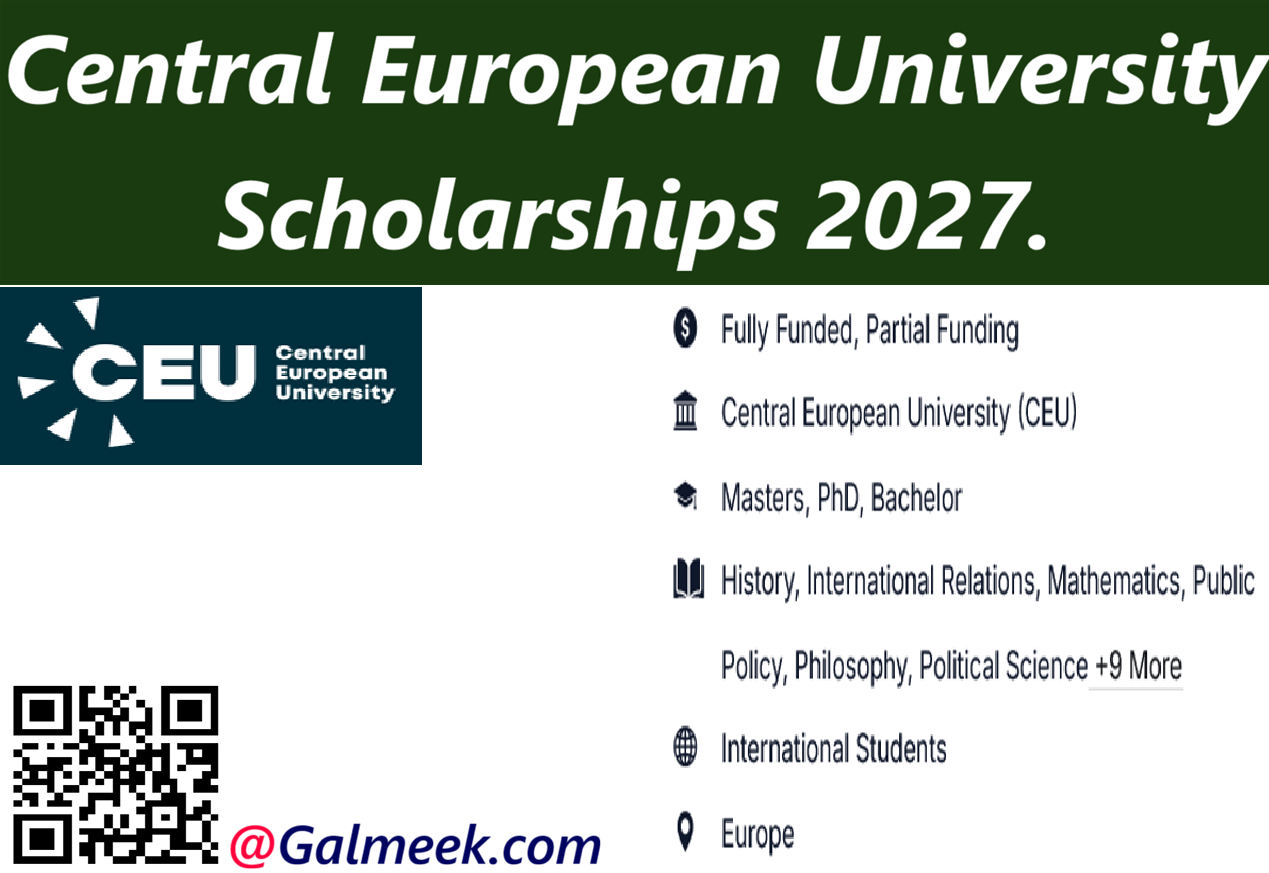
Central European University is an international research university known for its programmes in the social sciences, humanities, law, economics, public policy, and related fields. Although CEU was historically associated with Budapest, Hungary, it now primarily conducts its degree-granting operations in Vienna, Austria.
For the 2027–2028 academic year, CEU offers a range of financial aid opportunities for academically qualified students from different countries. Funding varies by programme and degree level. Doctoral students may receive a full tuition waiver and monthly stipend, while master’s students may qualify for tuition awards and stipend support. Undergraduate students can explore selected tuition scholarships.
Financial aid is competitive and subject to the university’s eligibility requirements, available funding, and application deadlines. Applicants should not assume that every scholarship covers all study and living expenses.
Types of Scholarships
-
CEU Doctoral Scholarship
CEU offers financial support to eligible doctoral students. The doctoral scholarship can include a full tuition waiver and a monthly stipend for up to 48 months, subject to the programme’s conditions and continued eligibility.
The published 2027 admission information lists a doctoral stipend of approximately €2,002 gross per month. The amount is gross rather than take-home pay, and applicable taxes or social security contributions may affect the amount received.
Applicants should check the current doctoral funding terms and the requirements of their chosen doctoral programme.
-
CEU Master’s Scholarships
Master’s applicants may be considered for merit-based financial aid. Depending on the award, support may combine a tuition discount with a monthly stipend.
Published scholarship information for the 2027 intake indicates that master’s tuition awards commonly cover around 50% to 80% of tuition fees, with full tuition coverage possible in exceptional cases. Separate stipend awards may also be available, with amounts varying by award and programme.
Funding is competitive, and applicants should review the current award terms rather than assume that all master’s students receive full funding.
-
Undergraduate Scholarships
CEU offers selected scholarships for eligible bachelor’s students. Undergraduate financial support is generally more limited than doctoral funding and may take the form of a partial tuition award.
Published information has also described Presidential Awards for outstanding undergraduate applicants. Availability, award values, and conditions for the 2027–2028 intake should be confirmed through CEU’s official admissions and scholarship pages.
Degree Level
Available opportunities depend on the specific programme and scholarship:
- Bachelor’s degree programmes.
- Master’s degree programmes.
- Doctoral and PhD programmes.
Applicants must confirm that their intended programme is eligible for the particular financial aid award.
Available Subjects
CEU offers programmes in a range of academic disciplines, including:
Business and Economics, Cognitive Science, Computer and Data Science, Environmental Sciences and Policy, Gender Studies, History, International Relations, Legal Studies, Mathematics, Medieval Studies, Philosophy, Political Science, Public Policy, Sociology and Social Anthropology, and Nationalism Studies.
Programme availability and scholarship eligibility may differ by academic year. Applicants should consult the official degree catalogue for the latest list of programmes.
Benefits
Depending on the scholarship and degree level, successful applicants may receive:
- Full or partial tuition fee coverage.
- A monthly stipend for eligible master’s or doctoral students.
- A full tuition waiver for eligible doctoral scholarship recipients.
- Health insurance benefits where included in the relevant funding package.
- Financial support for the standard duration of an eligible programme, subject to award conditions.
- Access to CEU’s international academic community and research facilities.
- Opportunities to study in an English-language academic environment.
Not all scholarships include every benefit. Applicants should also budget for any uncovered registration fees, accommodation, travel, visa costs, personal expenses, and other charges.
Eligible Nationalities
CEU welcomes applicants from a wide range of countries. Eligibility for financial aid is determined by the relevant scholarship terms and admission-round rules.
Applicants should pay particular attention to the restrictions affecting certain applicants from countries classified by CEU as visa-sensitive. These restrictions can affect which admission rounds are available to an applicant seeking financial aid.
Applicants should verify their eligibility for each round directly with CEU before submitting an application.
Eligibility Criteria
The requirements depend on the degree programme and scholarship. Generally, applicants should:
- Meet the academic entry requirements for their chosen CEU programme.
- Hold the appropriate previous qualification, or be on track to complete it before enrolment.
- Demonstrate the academic ability and potential required for competitive financial aid.
- Meet the programme’s English-language requirements.
- Submit all required application materials by the relevant deadline.
- Complete the funding section of the application if they wish to be considered for financial aid.
- Meet any nationality, visa, enrolment, or other conditions attached to the selected admission round and scholarship.
For doctoral admission, applicants generally need a relevant master’s degree or equivalent qualification. Master’s applicants generally need a recognised bachelor’s degree, while bachelor’s applicants must meet the relevant secondary education requirements.
Meeting the eligibility requirements does not guarantee admission or a scholarship.
English Language Requirements
CEU’s main degree programmes are taught in English. Applicants must satisfy the English-language requirements for their chosen programme.
Accepted tests, minimum scores, and possible exemptions depend on the programme and the applicant’s educational background. Applicants should consult the official programme requirements before deciding whether an English proficiency test is necessary.
Required Documents
The exact documents depend on the selected programme and degree level. Applicants may be asked to provide:
- Completed online application form.
- Academic transcripts and degree certificates.
- Curriculum vitae or resume.
- Statement of purpose or motivation letter.
- Letters of recommendation.
- Proof of English-language proficiency, if required.
- Research proposal or writing sample, where applicable.
- Additional programme-specific documents.
- Any other supporting materials requested by the admissions department.
Doctoral programmes may have additional research-related requirements. Applicants should follow the checklist shown in the online application system and on the relevant programme page.
How Winners Are Selected
CEU evaluates applicants according to the academic and programme-specific criteria established by the university. Scholarship decisions are competitive and may consider academic performance, the quality of the application, previous achievements, and potential for success in the chosen programme.
Funding is not guaranteed simply because an applicant is admitted. The university determines the type and value of any award according to its funding policies and available resources.
Applicants should read the terms of any scholarship offer carefully before accepting it.
Application Procedure
Step 1: Choose Your Degree Programme
- Explore CEU’s official programme catalogue and select a bachelor’s, master’s, or doctoral programme that matches your academic background and goals.
Step 2: Review the Admission and Funding Rules
- Check the entry requirements, application rounds, and scholarship conditions for your intended programme. If you require financial aid, confirm that the admission round you select offers funding for applicants in your circumstances.
Step 3: Prepare Your Documents
- Gather your academic records, CV, statement of purpose, references, and any additional materials required by the programme. Arrange any required English-language test results in advance.
Step 4: Complete the Online Application
- Submit your application through CEU’s official admissions system. Complete all sections carefully, including the funding section if you wish to be considered for financial aid.
Step 5: Submit Before the Applicable Deadline
- Ensure that your application is complete and submitted by the deadline for your chosen round.
- Applicants from visa-sensitive countries should pay particular attention to the restrictions on later rounds.
Step 6: Monitor Your Application
- Check your email and applicant account for requests for additional documents, interview invitations, admission decisions, and funding notifications.
Step 7: Review Your Scholarship Offer
- If selected, read the offer carefully to confirm tuition coverage, stipend amount, payment conditions, duration, and any fees or living expenses that remain your responsibility.
Application Deadline
CEU uses multiple admission rounds, and deadlines may differ by programme and applicant category.
For the 2027–2028 intake, the key dates published for the general admission cycle include:
- Round 1: 15 October 2026. This deadline has passed.
- Round 2: 2 February 2027. Financial aid may remain available for eligible applicants, but this round is not open to applicants from countries classified by CEU as visa-sensitive.
- Later rounds: Additional admission opportunities may be available, but institutional financial aid is generally not offered in rounds after the first two.
Because funding and visa eligibility can depend on the admission round, applicants should verify their individual eligibility on CEU’s official website before applying.