

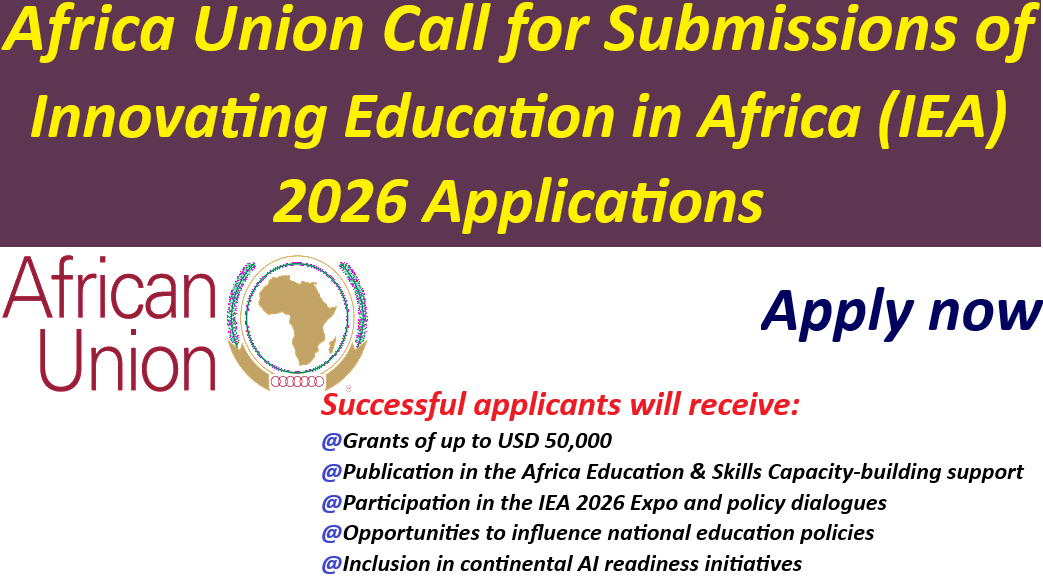
The Department of Education, Science, Technology, and Innovation of the African Union has officially launched the Innovating Education in Africa (IEA) 2026 Call for Submissions, inviting innovators across the continent to propose transformative solutions that address Africa’s most pressing education and skills development challenges.
Despite notable progress, education systems across Africa continue to face persistent challenges in access, equity, quality, relevance, and skills alignment.
Key statistics highlight the urgency:
- 20% of children aged 6–11 are out of school
- 33% of children aged 12–14 are excluded
- Nearly 60% of youth aged 15–17 remain out of education
These challenges disproportionately affect girls and are compounded by:
- Shortage and uneven distribution of qualified teachers
- Limited professional development opportunities
- Weak alignment between education outcomes and labour market needs
At higher levels, systems such as Technical and Vocational Education and Training (TVET) and universities face:
- Outdated curricula and weak industry linkages
- Limited digital integration and AI adoption
- Insufficient research capacity and innovation ecosystems
To address these issues, Africa needs scalable, cost-effective, and system-integrated innovations that strengthen education systems and align with continental strategies.
About Innovating Education in Africa (IEA)
Launched in 2018 by the African Union, IEA aims to identify, promote, and scale impactful education innovations across Africa.
Impact so far:
- 1,500+ education stakeholders engaged
- 180 innovations supported
- Up to USD 1 million mobilized
In 2026, the initiative expands its scope to include:
- Basic and secondary education
- Higher education and research ecosystems
- TVET and skills development
- Digital systems and AI integration
- Green skills and sustainability
IEA 2026 is seeking innovations in the following key areas:
#01. Basic and Secondary Education
- Foundational literacy and numeracy technologies
- Teacher professional development solutions
- AI-enabled assessment and adaptive learning
- Inclusive and gender-responsive education tools
#02. Higher Education & STI Ecosystems
- University-industry innovation hubs
- Research commercialization platforms
- Digital universities and hybrid learning systems
- Robotics and STEM centers of excellence
- Science parks, labs, and incubators
#03. TVET and Skills Development
- AI-integrated training models
- Robotics and automation training
- Green and climate-responsive skills
- Apprenticeship and dual training systems
- Skills certification aligned with AfCFTA
#04. AI, Robotics, and Emerging Technologies
- Robotics labs in schools
- AI-powered skills forecasting tools
- Simulation-based technical training
- Youth innovation hubs
- AI ethics, governance, and data privacy solutions
Eligibility Criteria
Applicants must:
- Be citizens of an African Union Member State
- Lead a legally registered organization
- Be implementing an education innovation with verifiable results
- Be directly responsible for the innovation (not intermediaries)
- Demonstrate scalability and alignment with continental frameworks
Note: Past IEA grant recipients are not eligible.
Successful applicants will receive:
- Grants of up to USD 50,000
- Recognition from the African Union
- Promotion across AU Member States and partners
- Publication in the Africa Education & Skills Innovations Handbook 2026
- Capacity-building support
- Participation in the IEA 2026 Expo and policy dialogues
- Opportunities to influence national education policies
- Inclusion in continental AI readiness initiatives
Application Process
Applications must be submitted online in English or French and include:
- Problem statement (100 words)
- Innovation description (500 words)
- Performance and impact report (500 words)
- Contribution to digital, green, AI, or skills ecosystems
- Proof of business registration
-
Download Guideline on Application Process Here
Submissions will be assessed based on:
- Innovation and uniqueness
- Scalability and sustainability
- Measurable impact
- Integration with public systems
- Industry relevance (for TVET)
- Gender and climate responsiveness
- Alignment with AU strategies (CESA, CTVET, STISA)
- Potential for commercialization and technology transfer
Deadline: 30 April 2026, 23:00 EAT (GMT+3)
The evaluation process includes:
- Eligibility Screening: 1–8 May 2026
- Technical Review: 8–20 May 2026
- Early Pitch (Virtual): May 2026
- Final Pitch: June 2026
Outcome:
- 50 shortlisted innovations
- 10 early pitch finalists
- 5 final pitch candidates
- 3 winners awarded grants
The Innovating Education in Africa 2026 Call is more than a funding opportunity; it is a platform to shape the future of education across the continent.
By supporting bold, scalable, and impactful solutions, the African Union aims to build inclusive, resilient, and future-ready education systems aligned with Africa’s long-term development goals.
For General Informations, Schorlaships, Intenships, Jobs, Research Grants, and Many More Both Local and International;
-
Follow to join WhatsApp Channel.
-
Telegram Channel.