
Fully Funded Health Collaborative Scholarships for MSc, MPhil & PhD Programs at Kwame Nkrumah University of Science and Technology (KNUST).
Follow to join the WhatsApp Channel.
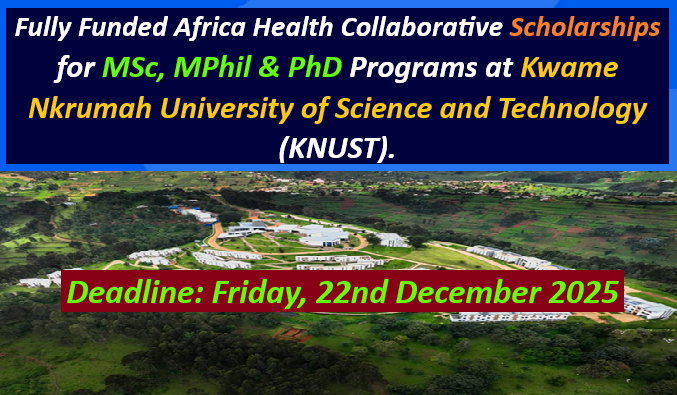
Fully Funded Health Collaborative Scholarships for MSc, MPhil & PhD Programs at Kwame Nkrumah University of Science and Technology (KNUST).
The Health Collaborative, hosted at the Kwame Nkrumah University of Science and Technology (KNUST) and supported by the Mastercard Foundation, has launched its fully funded 2025 scholarship call for eligible candidates across Ghana and all partner universities within the Africa Health Collaborative network.
This opportunity supports world-class training in public health, epidemiology, non-communicable diseases, entrepreneurship, health services planning, and pandemic preparedness.
The Health Collaborative aims to build a new generation of African health leaders through advanced academic training, cross-sector partnerships, and inclusive development.
Led by Professor Ellis Owusu-Dabo, one of Ghana’s top epidemiologists and global health leaders, the Health Collaborative strengthens African health systems by bringing together academic institutions, research centers, policymakers, entrepreneurs, and healthcare innovators.
The initiative is rooted in four strategic pillars:
- Building Primary Health Care capacity
- Strengthening health entrepreneurship ecosystems
- Creating advanced education pathways for critical health skills
- Developing a long-term Pan-African network for health innovation
These efforts have already led to the training of more than 2,000 health workers, the expansion of inclusive academic pathways, and the acceleration of African-led research and innovation.
FULLY FUNDED PROGRAMS AVAILABLE (2025 INTAKE).
Eligible applicants may apply for a fully funded Health Collaborative scholarship to study any of the following programs at KNUST’s School of Public Health (SPH) or School of Business (KSB):
Master’s Programs
- MSc Health Entrepreneurship (HENT)
- MPH/MSc Health Services Planning and Management (HSPM)
- MPH/MSc Global Health and Non-Communicable Diseases (NCDs)
MPhil Programs
- MPhil Health Systems Research and Management (HSRM)
- MPhil Field Epidemiology and Applied Biostatistics (FEAB)
PhD Programs
- PhD Public Health (Epidemics or Pandemics Preparedness and Response)
- PhD Public Health (Non-Communicable Diseases)
These programs respond to urgent health system needs, from NCD prevention and health systems strengthening to pandemic risk management and health innovation.
WHO CAN APPLY?
Scholarships are open to:
- Candidates in Ghana
- Alumni of Africa Health Collaborative partner universities
- Graduating students from the same institutions
Applicants are encouraged to review the full eligibility criteria on the official portal.
How to Apply
Deadline: Friday, 22nd December 2025
Official Website: https://hcmcf.knust.edu.gh/
The website provides complete details on eligibility, required documents, and step-by-step instructions.
Why Apply to the Health Collaborative?
- The fully funded scholarship offers:
- Complete tuition coverage
- Academic supervision by leading African global health experts
- Access to entrepreneurship and leadership development
- Opportunities for innovation, internships, and cross-sector collaboration
- Integration into a Pan-African network of universities and health partners
The initiative is uniquely designed to ensure African solutions are led by African experts, aligning with regional priorities and advancing long-term health transformation.
The Health Collaborative operates in partnership with:
- Mastercard Foundation
- KNUST School of Public Health
- KNUST School of Business
- Africa Health Collaborative Universities Network
- Leading research and innovation institutions across Africa
This strong ecosystem enhances research capacity, entrepreneurship, and professional advancement throughout the continent, creating meaningful pathways for young innovators and experienced practitioners alike.
By connecting universities, industry partners, and health institutions, it enables long-term collaboration, knowledge exchange, and opportunities that strengthen Africa’s ability to address emerging and persistent health challenges.