Full text: Speech by Minister for Works, Housing and Water Resources during Government Accountability Series.
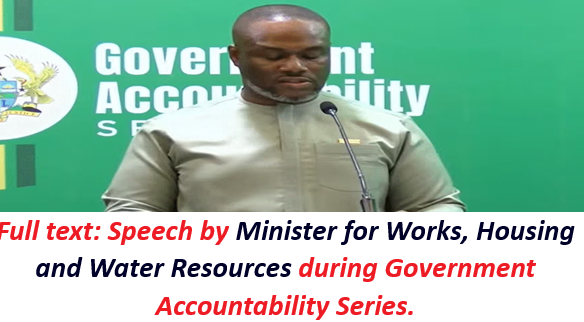
Full text: Speech by Minister for Works, Housing and Water Resources during Government Accountability Series.
The Minister for Works, Housing and Water Resources, Kenneth Gilbert Adjei, has briefed the public on the activities being undertaken by his outfit over the past year.
He gave the briefing during the Government Accountability Series on January 28.
The Minister’s address touched on Coastal Protection Works, Drainage and Flood Control Works, Operational Hydrology, Government Redevelopment Programme, National Rental Assistance Scheme (NRAS), and urban water supply, among others.
Please read the full text below:
STATEMENT DELIVERED BY HON. KENNETH GILBERT ADJEI, MINISTER FOR WORKS, HOUSING AND WATER RESOURCES, ON THE STATE OF THE WORKS, HOUSING AND WATER RESOURCES SECTOR AT THE GOVERNMENT ACCOUNTABILITY SERIES
THE HON. MINISTER OF STATE FOR GOVERNMENT COMMUNICATION
DIRECTORS AND HEADS OF DEPARTMENTS AND AGENCIES
FRIENDS FROM THE MEDIA
DISTINGUISHED LADIES AND GENTLEMEN.
Good morning.
It is an honour and a privilege to present the performance of the Works, Housing, and Water Resources Sector. As my first official engagement since assuming office as Minister, I consider this occasion both significant and timely. Open, transparent engagement remains central to good governance and national development. I extend warm greetings to all stakeholders and viewers joining us virtually and through social media platforms. Your participation underscores our shared commitment to inclusive governance and effective communication.
INTRODUCTION.
Distinguished Ladies and Gentlemen
The Ministry’s core mandate is rooted in the vision of building a resilient, modern society that enhances the economic and social well-being of all Ghanaians. Our work aligns with the Government’s resetting agenda, focusing on equity, sustainability, and transformation.
Over the past months of resetting, we have made notable strides across our three core areas: Works, Housing, and Water Resources. Our progress speaks to our enduring commitment to transforming lives, strengthening communities, and advancing the foundational work for Ghana’s sustainable development.
THE WORKS SUB-SECTOR.
Distinguished Ladies and Gentlemen, the functions of the Works Sub-sector center on:
- The protection of the country’s coastlines,
- Provision of urban drainage systems to mitigate flood disasters,
- Maintenance of government properties, and
- Delivery of quality architectural and engineering services
Coastal Protection Works
Ghana’s coastal belt continues to face significant threats due to rising sea levels, resulting in flooding, shoreline erosion, and community displacement. In response, this Ministry has prioritized strategic coastal protection to safeguard lives, livelihoods, and infrastructure.
Notable achievements include the successful completion of coastal protection works at Komenda, Ningo–Prampram, and Elmina:
At Komenda, the final phase of the coastal protection works, including the construction of a critical bridge, has been completed. This intervention has improved local connectivity and enhanced livelihoods, particularly in fishing communities.
In Ningo–Prampram, extensive dredging of the Djale lagoon basin was successfully executed, providing improved protection for residential dwellings and restoring public access to the beachfront.
Similarly, the third phase of the New Takoradi Sea Defence Project at Elmina has also been completed.
Altogether, these three projects have protected approximately 15km of coastline and offered protection to lives, livelihood, and properties along the coastline.
Additionally, the Ministry continues to implement coastal protection projects at various stages of completion:
- Dansoman Emergency Sea Defence – 95%
- Dansoman Emergency Sea Defence Phase II – 15%
- Dixcove Coastal Protection Project – 36%
- Anomabu Coastal Protection Project – 81%
- Cape Coast Coastal Protection Project Phase I – 80%
- Cape Coast Coastal Protection Project Phase II – 23%
- Aboadze Coastal Protection Project – 75%
- Axim Coastal Protection Project (Additional Works) – 12%
Distinguished Ladies and Gentlemen.
You will recall that in March 2025, H.E. John Dramani Mahama visited Solakokpe, Agavedzi, and Amutinu in the Ketu South Municipality, where tidal waves had displaced thousands of residents. During that visit, a firm commitment was made by H.E the President to address the devastation. True to that promise, I am pleased to announce that the contract has been awarded for Phase 2 of the Blekusu Coastal Protection Project, and in August this year, H.E. the President of the Republic of Ghana officially broke ground for the commencement of this critical project. Currently, the project is 25% complete and already, calm has been restored along the coastline.
Additionally, the Lower Volta Basin Sea Defence Corridor has been incorporated into WACA Resilience Investment Project Phase II, with technical assessments and environmental impact studies currently ongoing. Feasibility studies have also commenced for future coastal projects at Shama–Apor, Ningo–Prampram (Phase II), and Ada West.
Drainage and Flood Control Works
Flooding remains one of the most pressing infrastructural challenges in the country. Accordingly, addressing flooding has remained one of the topmost priorities of this government since assuming office. A Presidential Task Force on Flooding, led by the Deputy Chief of Staff, has been established to coordinate national flood mitigation efforts. This high-level team has since overseen the strategic coordination and acceleration of flood mitigation efforts across the country. As part of these efforts, comprehensive assessments have been carried out on major drainage infrastructure within key hydrological basins. These assessments have helped prioritize critical flood-prone areas for intervention and guided the design and execution of long-term flood mitigation strategies.
Under the National Flood Control Programme (NFCP) spanning 2020, 2023, and 2024, this Ministry is implementing critical interventions to reduce flood-related risks. Notable progress has been made in the construction, rehabilitation, and desilting of drains across various regions. These works have contributed significantly to improving the capacity of drainage systems, thereby reducing flood risks in identified hotspots. Collectively, the interventions have resulted in the construction of approximately 1.76km of storm drains during the period under review.
As part of the Greater Accra Resilient and Integrated Development (GARID) Project, performance-based dredging of the Odaw Channel has continued from the lined sections at Caprice and Circle. A post-dredging survey indicates that a total of 90,936.00m3 cubic meters of sediment has been dredged and transported to the designated handling sites. Similarly, upgrading interventions, including the construction of storm drains, local drains, major culverts, road paving, as well as other road works in Alogboshie, Akweteyman, and Nima, have continued, and the works are 58%, 62%, and 65% complete respectively. Other drainage improvement works have commenced at Achimota, Nima-Paloma, and Kaneshie.
As part of the non-structural measures, various equipment has been acquired and installed across key water bodies in Accra to support the Flood Early Warning Response System (FEWS) for Accra. The development of the FEWS Accra is advanced, with servers now installed and configured for the Ghana Hydrological Authority (Hydro), the National Disaster Management Organisation (NADMO), and the Ghana Meteorological Authority (GMet). Furthermore, operational testing of the FEWS has been completed, alongside User Acceptance Testing and training sessions for all three user agencies.
In response to emerging flood risks in the Greater Kumasi Metropolitan Area and drawing on lessons from the ongoing GARID Project, the Government has secured grant funding to conduct strategic flood risk assessments across three key drainage basins—Sisa, Wiwi, and Aboabo. Two consultants have been engaged to assess community-specific vulnerabilities in low-income areas such as Aboabo and Asawasi, as well as identify flood-prone zones within the broader Kumasi urban area. These studies include rapid hazard and risk assessments, offering short-, medium-, and long-term recommendations for flood mitigation.
The consultants have submitted draft final reports to the Ministry, recommending a range of flood mitigation measures. Short-term proposals include dredging and drainage cleansing, enforcing building regulations, adopting flood-sensitive land use planning, and establishing a Kumasi Flood Early Warning System. For the medium to long term, the reports suggest removing key bottlenecks in major drains, implementing a “Room for the River” approach to restore floodplains with prospects for resettlement, while establishing a coordinated, sustainable waste management system for the metropolis.
These measures are pre-feasibility level findings and recommendations, and require a deepening of the studies that would subsequently lead to the preparation of engineering designs for contractors to be procured for the civil works. In the coming year, the Ministry will seek the needed resources to begin the processes that should bring relief to the people of Kumasi.
The Government remains resolute in its commitment to sustainably addressing flooding and its related challenges. Through continued investment, enhanced institutional collaboration, and community engagement, the state is working to build flood-resilient infrastructure and ensure the safety and well-being of all citizens.
Operational Hydrology
To modernize Ghana’s hydrological monitoring systems, the Ministry has installed three telemetry units along the Black and White Volta River systems. To enhance flood forecasting and real-time hydrological monitoring, three advanced telemetry systems have been installed at strategic points: Lawra on the Black Volta, Yarugu (Kobore), and Nawuni along the White Volta River in Northern Ghana. These installations significantly strengthen our capacity for data-driven early warning systems and disaster preparedness.
In a complementary effort, the Ghana Hydrological Authority, in partnership with the Volta River Authority, has rehabilitated several previously malfunctioning gauging stations within the Volta River Basin. The renovated stations are located at Prang (Pru River), Seneso (Sene River), Yendi (Daka River), Kpassa (Kpassa River), Dodo-Tamale (Asukawkaw River), Ahamasu (Wawa River), and Vakpo (Dayi River). These upgrades are critical for comprehensive basin-wide monitoring and timely flood response, and to support Hydropower management by the VRA.
Furthermore, an automatic discharge keeper has been installed at Avenor and Weija in the Odaw River and Densu River catchment areas, significantly improving flow measurement and generating actionable data to support urban flood management in Accra.
The Ghana Hydrological Authority has also installed river flow monitoring equipment earlier this year at Sogakope in the Lower Volta Basin, Ashalaja in the Densu River Basin, and Pokuase in the Odaw catchment, all aimed at monitoring flows and collecting the necessary data and information for flood management.
THE HOUSING SUB-SECTOR
Distinguished Ladies and Gentlemen,
Ghana continues to grapple with a substantial housing deficit, currently estimated at over 1.8 million units. This gap is further exacerbated by widespread affordability challenges, which prevent a large portion of the population, particularly low- and middle-income earners, from accessing safe, secure, and dignified housing.
Rapid urbanization has intensified the situation. With more than half of the country’s population now residing in urban areas and projections indicating that this could rise to over 72% by 2050, the demand for housing in metropolitan centres such as Accra, Kumasi, and Takoradi has grown exponentially. Unfortunately, the supply of housing has not kept pace with this demand, resulting in overcrowding, soaring property prices, and the expansion of informal settlements.
This scenario underscores the urgent need for coordinated, forward-looking interventions that simultaneously address housing supply and affordability, while promoting sustainable urban planning to match Ghana’s evolving demographic realities.
The Ministry has continued with its efforts to complete the stalled affordable housing projects across the country. TDC Ghana Ltd has continued work on 800 housing units under the Kpone Affordable Housing Project at Tema Community 26. These units are at various stages of completion and progressing steadily.
Having regard to the quest to position TDC Ghana Ltd as a key player in Ghana’s housing industry, the President of the Republic of Ghana, His Excellency John Dramani Mahama, cut the sod last year for the construction of the Oxygen City Housing Project in the Volta Region. This landmark initiative seeks to address Ghana’s housing deficit through the development of 800 modern two- and three-bedroom apartments. This project is the first by TDC Ghana Ltd outside the Tema Acquisition Area. The 1,860-acre Oxygen City Housing Project is envisioned as a well-planned, serviced, and economically integrated community, featuring essential amenities such as a school, hospital, shopping mall, gym, and recreational center. The project has commenced and is scheduled for completion in June 2027.
Additionally, the Ministry has intensified engagement with the selected developer for the completion of the Saglemi Affordable Housing Project. Following the completion of the developer selection process led by Deloitte Ghana, the Transaction Advisors, the Heads of Terms have been duly signed by both parties, and the Shareholders’ Agreement has been drafted and mutually agreed upon. The document is currently with the Attorney-General for review and finalisation. Meanwhile, the Joint Venture (JV) arrangement has been concluded among all parties and is expected to be formally executed in the coming weeks.
Similarly, the State Housing Company Limited has continued work on key projects, including the Surge Homes development at Amrahia and the SHC Gardens project. Both projects are targeted for completion by the end of 2025, with progress currently at 68% and 70%, respectively.
Government Redevelopment Programme
The Government Redevelopment Programme is a strategic initiative aimed at revitalizing prime public lands and infrastructure to better serve the evolving needs of public servants and the urban environment. This programme seeks to transform underutilized state-owned properties into modern residential and administrative spaces that reflect efficient land use and sustainable development goals.
To date, 68 new housing units comprising 3-bedroom apartments and Townhouses have been completed at Lartebiokoshie, Labone, and Roman Ridge for use by public servants. An additional 422 units are at various stages of construction at Airport, Ridge, Cantonments, Lartebiokoshie, and Labone.
Akosombo Dam Spillage: Resettlement of Displaced Communities
Following the devastating impact of the Akosombo Dam spillage, the Ministry, in collaboration with the nineteen (19) affected District Assemblies, went through an extensive process to validate a total of 2,225 housing units to be reconstructed for the flood victims across four (4) regions. Phase I of the resettlement efforts consists of 1,010 housing units within the three Critical Impact Zones (CIZs): North Tongu, Central Tongu, and South Tongu Districts in the Volta Region. Site mobilization and construction activities are currently active in eight (8) locations across the three (3) Districts.
The ongoing construction works are at varying levels of completion. While sites such as Agbetikpo-Ganyakope and Battor Aveyime have made steady progress despite logistical and land acquisition hurdles, others, including Mepe and Nglorlekpoe have experienced delays due to unresolved land ownership disputes, legal challenges, and poor terrain conditions. Across all locations, most construction activities remain at the substructure phase, influenced by varying factors including site accessibility and contractor performance.
Greenville District Housing Programme (DHP)
As part of the decentralisation agenda and in line with the Government’s commitment to affordable housing, the Ministry has initiated the Greenville District Housing Programme, a strategic intervention targeting low- to middle-income earners at the district level.
In its pilot phase, the programme has commenced in eight districts:
South Dayi, Asuogyaman, Akyemansa, Ajumako Enyan Essiam, Atwima Kwanwoma, Dormaa West, Bole, and Tamale, and at various levels of completion.
Each district is earmarked to receive 20 two-bedroom housing units as part of the first phase of the project. A hybrid construction approach using compressed earth bricks and sandcrete blocks will be adopted, prioritizing sustainability, cost-efficiency, and resilience.
The official launch of the Greenville District Housing Programme is expected in the coming weeks. This milestone marks a significant step toward decentralizing housing delivery and advancing social equity, inclusivity, and improved living standards across the country.
National Rental Assistance Scheme (NRAS)
The National Rental Assistance Scheme, established by the Government in 2023 as a social housing programme, aims to facilitate access to rental properties for qualifying beneficiaries by providing a rent advance. The Scheme is currently being piloted in six (6) Regions, namely Greater Accra, Bono East, Northern, Eastern, Western, and Ashanti Regions.
In 2025, the Scheme successfully facilitated the payment of rent advance for 2,031 Ghanaians across its six operational regions, bringing the cumulative number of beneficiaries since inception to 4,732.
I am glad to state that so far, the disbursement recovery rate is about 99%, indicating that the government’s seed money is fully recoverable and in circulation.
The programme’s eligibility criteria, application process, and beneficiaries’ success stories highlight its effectiveness in addressing housing needs and enhancing community well-being, and the government is poised to take the necessary steps in the short to medium term, to scale up the operations of the Scheme across all sixteen (16) Regions of the country.
Review of Rent Laws
Recognizing the critical role of rental housing in national development, the Ministry has continued the review of the Rent Act, 1963 (Act 220) and the Rent Control Law, 1986 (P.N.D.C.L 138). These reforms aim to modernize outdated legislation, eliminate regulatory bottlenecks, and incentivize private sector investment in rental housing. Key priorities include maintaining tenant protections, especially for low-income and vulnerable groups, while also regulating hostel accommodations across the country. During the review period, a national rent dialogue was undertaken to validate and streamline the proposed amendments. The Ministry is taking the necessary steps to resubmit the Bill to Cabinet and subsequently Parliament for consideration and approval.
THE WATER SUB-SECTOR.
Water Resources Management
Distinguished Ladies and Gentlemen,
Ghana’s annual renewable water resources are estimated at approximately 54 billion cubic meters, with over 70% of this volume sourced from the Volta Basin shared among six riparian nations, including Ghana. However, per capita renewable water availability has been on a steady decline from approximately 3,000 cubic meters per person per year in the 1960s to about 1,650 cubic meters as of today. This figure falls below the United Nations’ threshold of 1,700 cubic meters, indicating that parts of the country are already experiencing a water stress situation.
Despite the abundance of natural water resources, Ghana continues to face significant and multifaceted challenges that hinder sustainable water resource management. These include:
- Climate variability, such as erratic rainfall, drought, and flood have become more intense and frequent.
- Illegal mining, commonly referred to as galamsey, continues to pollute our rivers and threatens our ecosystems.
- Deforestation and poor land management practices continue to degrade our watersheds. Over 60% of Ghana’s river catchments have been subjected to unsustainable land use practices.
- Inadequate enforcement of regulations, overlapping institutional mandates, limited resources, and a lack of real-time data hamper coordinated interventions and further compound our challenges.
- Uncontrolled urban sprawl, which has led to the encroachment of wetlands, riverbanks, and recharge zones.
- Borehole drilling, largely unregulated, is depleting aquifers, while industrial expansion often disregards effluent control measures.
To address the challenges outlined above, the Water Resources Commission, with the support of government and other development partners, has raised 34,000 seedlings as part of the buffer zone restoration programme, continued with the implementation of Nature-based Solutions, and established Watershed Investment Programmes for some river basins. The Commission has also adopted the bottom-up approach of water resources management by establishing Local Water Governance Systems where riverine communities are directly engaged to support the management of our water resources.
In support of efforts to combat illegal mining (galamsey), especially within water bodies, the Commission has developed the Water Resources Assessment System (WRAS) which is currently in its operational testing phase alongside User Acceptance Testing and training sessions. The system will be linked with the Mining Cadastre Administration System (MCAS) of the Minerals Commission to enhance the government’s vision of streamlining the permitting and licensing process for small-scale mining while reducing the turnaround time.
Additionally, two Legislative Instruments (LIs) for the management of Riparian Buffer Zones and the Control of Waste Discharge and Management of Water Quality within the country are being drafted with the support of the Attorney General’s Officefor onward submission to Parliament for consideration. These LIs, when adopted, will minimise encroachment and pollution of water bodies in the country.
WATER SUPPLY
According to the Ghana Statistical Service (GSS) and the WHO/UNICEF Joint Monitoring Programme (JMP), approximately 88% of Ghana’s population has access to basic water services. However, only 44% of the population benefits from safely managed water services, defined as an improved water source that is on-premises, available when needed, and free from contamination.
Urban water access is relatively high, at 96%, whereas rural areas report an average of 74%, with certain regions experiencing access rates as low as 42%. It is important to note that these figures include communities where service is often intermittent and unreliable.
One of the critical challenges facing urban water supply is non-revenue water, which stands at an estimated 50%, far above the international benchmark of 25%. Meanwhile, nearly 4 million Ghanaians continue to depend on unimproved, limited, or surface water sources.
Other persistent issues impacting water supply include aging infrastructure, low investment in maintenance, poor cost recovery, high operational costs, pollution of water sources, and climate-induced variability.
Interventions
To address these challenges, the Ministry has continued the implementation of key interventions aimed at expanding and improving water services nationwide:
Urban Water Supply Projects
- Keta Water Supply Project – 72% complete
- Wenchi Water Supply Project – 91% complete
- Sekondi-Takoradi Water Supply Project – 89% complete
The government will continue work on all ongoing water supply projects at Keta, Wenchi, and Sekondi-Takoradi, and commence work on the Damango and Sunyani Water Supply Expansion Projects. The government will also explore the opportunity to conclude all financing arrangements for other water supply projects at Tamale, Yendi, Techiman, and Tarkwa.
The Danish Government has also earmarked some Grant support to expand water supply services to low-income and high-density areas in Wa and Bolgatanga to address water supply challenges to the vulnerable in these areas.
Rural Water Supply Projects
- Asankragwa – 72% complete
- Sefwi Wiawso – 57% complete
- Duadaso – 50% complete
- Kweiman Danfa – 75% complete
- Goaso – 59% complete
- Juaben – 65% complete
- Aveyime – 81% complete
- Adu Banso – 70% complete
Water Sector Reform
The Ministry would continue to pursue Water Sector Reforms in line with the broader objectives of the revised National Water Policy.
Studies are currently ongoing to define clear and sustainable pathways aimed at strengthening institutional coordination, improving service delivery, and enhancing financial sustainability.
CONCLUSION.
Distinguished Ladies and Gentlemen,
In the face of significant resource constraints, the Ministry of Works, Housing, and Water Resources remains resolute in its commitment to deliver transformative policies, programmes, and projects that positively impact the lives of Ghanaians.
As we confront the complex challenges of infrastructure development and environmental sustainability, we urge all stakeholders both State and Non-State Actors to adhere strictly to planning regulations, promote responsible development practices, and demonstrate improved civic responsibility, particularly in the areas of sanitation and household waste management.
Let us reaffirm our shared commitment to building a resilient, inclusive, and forward-looking Ghana. On behalf of the Ministry, I extend our deep appreciation to all partners and stakeholders for your continued support. We remain dedicated to creating infrastructure that meets today’s needs while laying a solid foundation for future generations.
May God bless us all.