


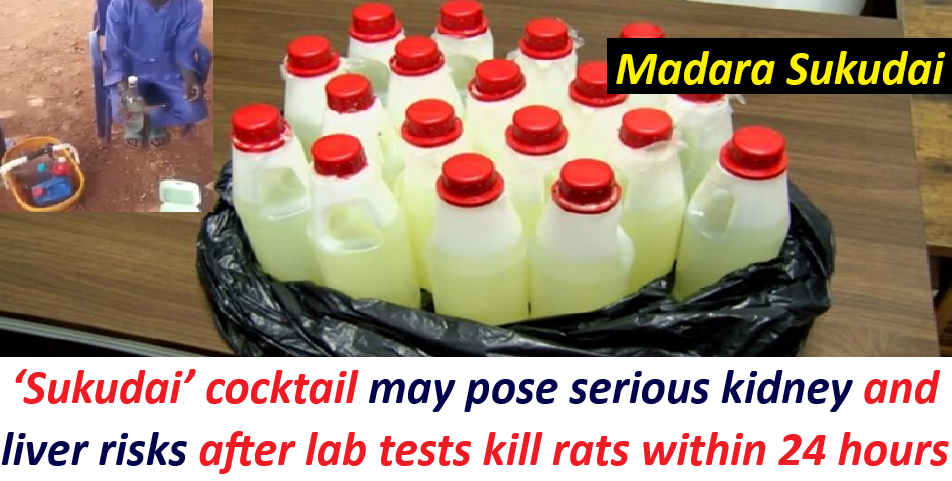
National Security has launched a special operation to rid the streets of Kumasi of a popular toxic cocktail sold as a ‘heart cleanser.’
It comes as preliminary investigations by the Department of Pharmacology at the Kwame Nkrumah University of Science and Technology (KNUST) revealed the herbal concoction, known in Hausa as ‘Madara Sukudai’, contained substances harmful to human health.
Madara Sukudai, until now, has endeared itself to many Ghanaians, especially the youth. It is believed to contain heart-cleansing potency by patrons of the drink.
The concoction is commonly sold in Zongos and auto mechanic shops. It is often sold by some Nigerien nationals and, sometimes, Ghanaians.
However, an acute toxicity test conducted by the Department of Pharmacology at the KNUST revealed the drink is toxic, as it was found to contain acetone, zinc chloride, and ethanol.
All laboratory rats administered low, medium, and high doses of the chemical used to prepare the concoction died within 24 hours, raising health concerns.
The dead rats exhibited some uneasiness a few seconds after taking the concoction, which also melted plastic take-away bowls.
“We used rats for this experiment and we gave different doses from low to medium and then high doses of the product to the group of rats in each cage and within 24 hours all the rats died and we usually look at their behaviour etc and then but before we could say jack all the rats had died and initially we put some of the samples in in universal bottles which are usually plastic and they all melted and then just a spill off of the product also on the takeaway containers,” Head of the Department of Pharmacology at KNUST, Professor Mrs Cynthia Amaning Danquah told Joynews.
While acetone is a potent solvent typically used in paint thinner and nail polish remover, zinc chloride is a highly corrosive chemical used in wood preservation and dry cell batteries. Ethanol, on the other hand, is a common alcohol believed to be the base for the other toxins.
Head of the Department of Pharmacology at KNUST, Professor Mrs Cynthia Amaning Danquah, says the Department regularly collaborates with the Food and Drugs Authority (FDA) and the Ghana Standards Authority to test herbal products.
“Preliminary, we discovered that the product contains organic solvents like acetone, zinc chloride and ethanol. Just to give a fair idea to the layman, acetone is usually found in the nail polish that women use for acrylic nails, so we don’t take it. Then, zinc chloride is also corrosive in terms of organic solvents and other things.
So it can cause gastric irritation if taken, so it immediately tells you that this is not something that should even be consumed. So, right on surface value, this is not something that should be consumed. It is corrosive and it will cause GI (gastrointestinal) irritation and can result in serious damage to the liver and the kidneys, so to learn that people are consuming this is usually it’s a great concern to us.”
Authorities at KNUST have scheduled further chronic toxicity investigations, which will include further biochemical tests on the deceased rats.
Even before the comprehensive investigations are completed, Prof Mrs Danquah wants the public to stay away from the cocktail drink since it poses a significant danger to human health.
“Some of these things take time, like chronic disease studies, you should do at least one to three months. I mean, and to be sure of what is actually happening, because as I said we’ll take out the organs and then do further biochemical tests, measure the liver enzymes and look at all the cells under the microscope, do some haematology, etc., and so we’ll just advise that people stay away from it.”
The investigation follows the arrest of a trader who deals in the chemicals used in the preparation of the ‘Sukudai’ drink by National Security operatives in Kumasi.
It comes after several weeks of surveillance and intelligence gathering, as the product is sold in secrecy.
Ashanti Regional Deputy Security Coordinator Alhaji Njeh Abdallah Umar led the operation to arrest the trader at Aboabo.
He describes the presence of the drink on the streets of Kumasi as a national security concern.
“What has been given to a rodent in less than 24 hours has died. You don’t know who is consuming it, but they are Ghanaians. And the most interesting aspect is that those selling it, when you tell them to drink it, they will not.
Even if you force them, they are not going to drink it. And it has been in the system for many years. When I was young, I saw them selling it in town.
So we know what is happening now. Our health issues, internal organs, the kidneys, the liver and other organs, as far as the health issues are concerned. So it means we have to rise up and fight it.”
A consultant nephrologist at the Komfo Anokye Teaching Hospital is raising concerns over the ‘heart cleansing’ tag of Sukudai.
“These things are not things that you hope, especially the zinc chloride and then the acetone that you would want to take into your body. But my thinking is that it gives them some burning sensation in their chest. And that is what they are calling “cleansing their chests”, which I’m afraid, because of how corrosive the zinc chloride is, it might end up messing with or affecting their gut, and not that alone,” says Professor Elliot Koranteng Tannor.
Professor Elliot Koranteng Tannor, whose office has been seeing unexplained symptoms of kidney cases for a period of time, is warning against the consumption of such dangerous concoctions.
“If it is absorbed into their body, then there’s a tendency it can affect their liver and their kidney. But from the research that was done, it is clear that most likely if they take it in toxic amounts, they might not live long enough for us to even see its effect on their kidney and liver and so on and so forth, because of the nature of what they are taking.
For me as a nephrologist, the other worrying aspect is that if you are to see this person in your ER or in your hospital, with some complaints you cannot even understand, they will not even tell you what medications they took. And you’ll be scratching your head about why their kidney function or their liver function is this way.
Prof Tannor is hopeful that the completion of the investigations will help advance care for a trend of unexplained kidney cases.
“This calls for an interest in trying to understand what is going on. And I think from the interactions we have had, it is even possible that comparing the dosage from street to street might not be the same. So far, we know the one that you saw is discontent.
What if somebody else is adding something else to make it more potent, which might end up causing more harm than even we saw with this lab rat? And I think that is what makes it a public health issue for us to address.”
Meanwhile, the Ashanti regional office of National Security is liaising with other counterparts to rid Ghana of Sukudai.