

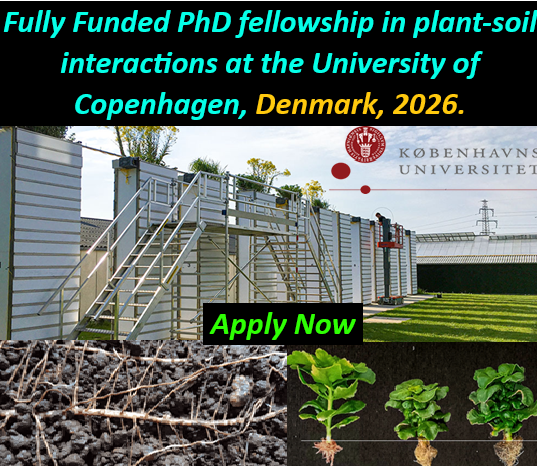
Fully Funded PhD fellowship in plant-soil interactions at the University of Copenhagen, Denmark, 2026.
The Department of Plant and Environmental Sciences (PLEN) at the University of Copenhagen invites applicants for a PhD fellowship in quantifying multi-species benefits of ley mixtures in relation to plant root growth, potential stabilisation of soil organic matter, and soil biota.
The project is part of the research project “Grassy – Can diversity deliver ‘climate-smart’ grassland systems?”, financed by the Independent Research Fund Denmark.
About the project.
- The overarching project aim is to unravel the mechanisms that govern how mixtures of grasses, legumes, and forbs can deliver more resilient, biodiverse, and carbon (C)-rich grassland (ley) systems.
- Part of the work will revolve around a field trial in the state-of-the-art ‘DeepRootLab’ at the crop sciences section of the department.
- Objectives will involve (amongst others) quantifying plant productivity, root growth, C/N in soil organic matter (SOM) fractions, and assessing soil biodiversity, particularly earthworms.
- As part of this, activities will include the use of isotopic labelling techniques, sampling and imaging of roots, soil, and earthworm casts, soil analyses and fractionation, and plant growth experiments in both field and controlled (glasshouse) conditions.
Who can apply?
- Looking for candidates within the fields of plant science, soil science, agronomy, agroecology, soil biology, or a closely related field, with an interest in fundamental and applied aspects of crop ecology and soil science.
- And seeking a motivated and ambitious individual with good interpersonal and communication skills, and a very good spoken and written English level.
Applications are encouraged from candidates with a mix of the following or closely related competencies:
- strong knowledge and interest in plant-soil interactions, including root growth and root traits, and understanding of soil (bio)geochemical processes, with special emphasis on soil organic matter dynamics and rhizosphere processes
- experimental experience in crop field studies and/or plant growth in controlled conditions, including plant and soil sampling and analyses, use of isotopes, and root imaging.
- ability to translate theoretical scientific questions into practical experiments and measurements
- ability to analyse and interpret complex data.
- ability to work independently and take initiative, good hands-on problem-solving skills, and the capacity to acquire new skills.
Research shows that women and other underrepresented groups often hesitate to apply unless they meet every requirement.
If you are excited about this position and believe you can contribute, you are strongly encouraged to apply, even if your experience does not perfectly match every point.
Your curiosity, motivation, and the potential and willingness to learn are greatly valued.
Responsibilities and tasks in the PhD programme
- Carry through an independent research project under supervision
- Complete PhD courses corresponding to approx. 30 ECTS / ½ FTE
- Participate in active research environments, including a stay at other research institutions (WUR/TUB)
- Teaching and knowledge dissemination activities
- Write scientific papers aimed at high-impact journals
- Write and defend a PhD thesis based on your project
Eligibility
- Professional qualifications relevant to the PhD project
- Relevant publications
- Relevant work experience
- Other relevant professional activities
- Curious mindset with a strong interest in the development of sustainable crop systems that are resource-use efficient, biodiversity-friendly, and promote important ecosystem services
- Proficiency in spoken and written English, including skills in academic writing, is essential. Your command of the English language is expected to be at the C1 level.
Application and Assessment Procedure
Your application, including all attachments, must be in English and submitted electronically by clicking APPLY NOW.
Please include:
- Cover letter/motivated letter of application (max. one page)
- A short reflection on your research interests, experience, and how the project aims can be approached (max. one page)
- Curriculum vitae including information about your education, experience, language skills, and other skills relevant to the position
- Original diplomas for Bachelor of Science or Master of Science and a transcript of records in the original language, including an authorized English translation if issued in a language other than English or Danish.
- If not completed, a certified/signed copy of a recent transcript of records or a written statement from the institution or supervisor is accepted.
- Publication list (if possible)
- Contact information for two referees (to contact upon request)
Application deadline:
The deadline for applications is 8 February 2026, 23:59 GMT +1.
After the deadline, qualified applicants will be selected for academic assessment by an unbiased expert assessor.
You will be notified whether you will be passed for assessment.
The assessor will assess the qualifications and experience of the shortlisted applicants with respect to the above-mentioned research area, techniques, skills, and other requirements, and will conclude whether each applicant is qualified.
The assessed applicants will have the opportunity to comment on their assessment.