

Follow to join the WhatsApp Channel.
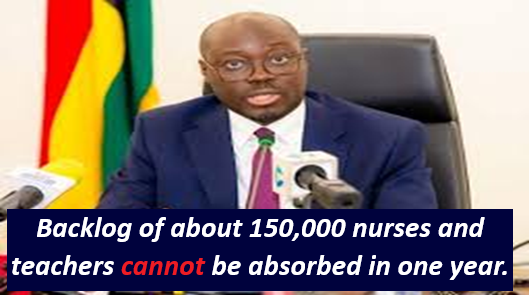 Backlog of about 150,000 nurses and teachers cannot be absorbed in one year.
The Finance Minister, Dr. Cassiel Ato Forson, stated that the government cannot immediately employ all the more than 150,000 nurses and teachers currently awaiting recruitment into the public sector.
He said this while speaking on the Citi FM Morning Show with Bernard Avle on Friday, 14th November.
The Minister explained that the nation’s compensation budget cannot sustain the mass absorption of all qualified graduates within a single year.
According to him, although the government acknowledges the pressing need for more personnel in key public service areas, recruitment must be phased carefully to avoid destabilizing the budget.
“We cannot absorb one hundred and fifty thousand health and education graduates in a single year. The ninety billion compensation budget already includes planned recruitments for essential sectors such as doctors, teachers, and nurses,” he said.
The finance minister also noted that while the backlog poses genuine concerns, the recruitment process must align with both fiscal space and sectoral priorities to ensure sustainability.
His comments come after he presents the 2026 National Budget to Parliament on Thursday, 13th November 2025, during which the government announced a GH¢33.3 billion allocation to the Ministry of Education to support a wide range of programmes aimed at boosting access, quality, and equity in the country’s education system.
And additional GH¢9.9 billion was allocated to the Ghana Education Trust Fund (GETFund) to strengthen infrastructure development across educational institutions.
This commitment, Dr. Forson emphasised, reflects the government’s recognition of both the operational and developmental needs of the sector.
The 2026 Budget also makes significant provisions for key educational initiatives.
- GH¢4.2 billion has been allocated to support the continued implementation of the Free Secondary Education policy, ensuring that financial barriers do not prevent eligible students from accessing senior high schools.
- Under the Ghana Secondary Learning Improvement Programme (GSLIP), GH¢1.1 billion has been earmarked to improve learning outcomes and support efforts to phase out the double-track system.
- The No-Fee-Stress policy, which removes basic school fees for public school students, will receive GH¢537 million in 2026, easing the financial burden on families.
- To further promote inclusivity, GH¢25 million has been allocated for Free Tertiary Education for Persons with Disabilities.
Additionally, GH¢3 billion has been set aside for the provision of essential teaching and learning materials.
- This includes supplying four sets of kindergarten books and workbooks to about 200,000 learners, four sets of primary textbooks for two million learners, and nine sets of JHS 3 textbooks for 500,000 learners.
- Dr. Forson reiterated that while the government is committed to expanding job opportunities in the education and health sectors, all recruitment decisions must reflect the country’s fiscal realities.
- He assured unemployed graduates that the government will continue to recruit within essential sectors, including doctors, nurses, and teachers, but emphasised that such recruitment must be implemented gradually to ensure long-term sustainability.